
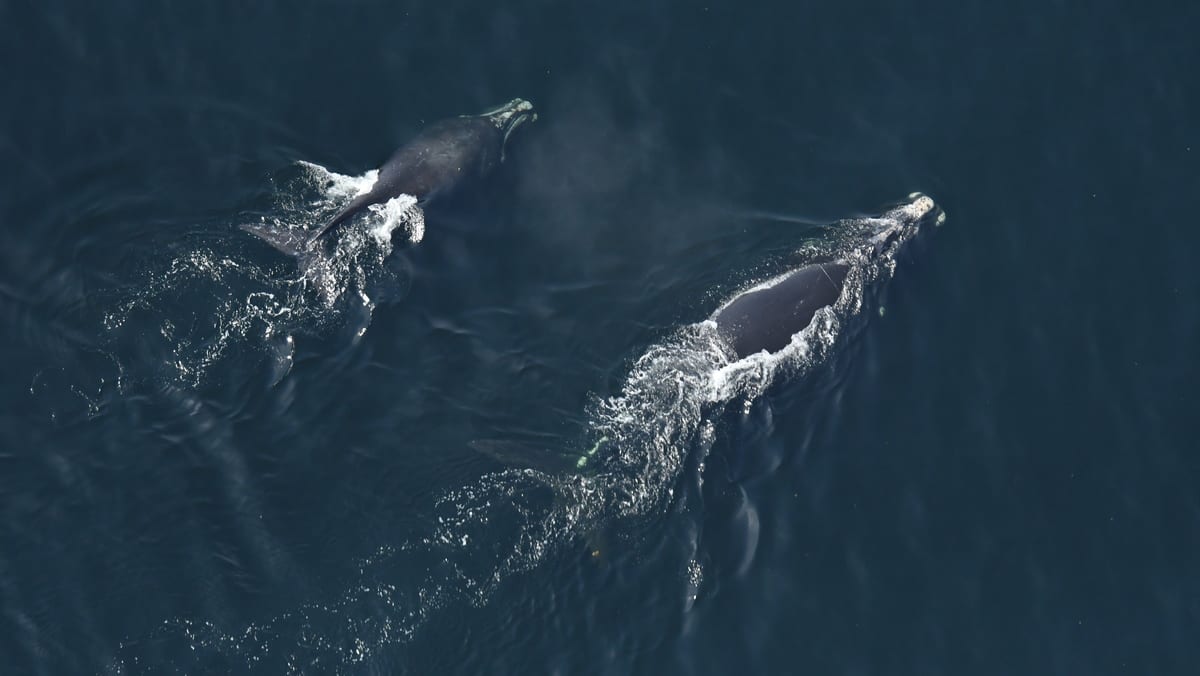

On a cruise ship off the coast of California, Sara Lesser looks wistfully at the dozens of dolphins playing in the ship’s wake. This summer, the marine heatwave makes this spectacle rare, according to this guide from the Long Beach Aquarium.
During daily excursions, “the number of whales and dolphins that we observe is lower than in a normal year,” the naturalist tells AFP.
The warming of the ocean surface pushes the anchovies and sardines on which these mammals feed to migrate towards cold waters, at depth or further north.
Dolphins and whales “follow their food, and we therefore encounter fewer people,” she summarizes.
At 39 years old, she regularly raises awareness among tourists, because this difficulty in seeing cetaceans is only a foretaste of the upheavals undergone by the marine ecosystem.
Surface temperatures along the California coast are currently 3 to 4°C warmer than normal, according to the National Oceanic and Atmospheric Administration (NOAA).
This heatwave has lasted “for around six months”, recalls Andrew Leising, specialist in marine heat waves within the institution.
The heatwave is worrying because it coincides with the return of El Niño, this warming of the waters of the equatorial Pacific which periodically disrupts the global climate.
This year, scientists predict it will be among the strongest on record.
Vulnerable sea lions
“There is a good chance that this El Niño will be more powerful than in 2015-2016,” fears Mr. Leising, recalling that at the time, a record ocean heat wave had traumatized California.
This exceptional episode was born from conditions quite similar to those currently observed: the arrival of the “enfant terrible of the Pacific” had aggravated a marine heatwave already in place since 2014.
The ocean had become so hot that thousands of birds had died because they could not catch fish from the surface. Many carcasses of malnourished sea lions and whales had also washed up on the beaches.
In recent months, dozens of pelicans and cormorants have been found dead near San Diego.
Mr. Leising now expects to see sea lions, California’s iconic sea lion species, suffer.
When temperatures rise, females “abandon their young because they go elsewhere in search of food,” he explains.
Heat also promotes the proliferation of toxic algae, containing domoic acid, which contaminates the anchovies and sardines they ingest. Sea lions can thus “fall ill, wash up on shore and possibly die”.
In Monterey Bay, south of San Francisco, poisonous algae is so numerous that two humpback whales were found dead on the shore in early June.
White sharks close to the coast
“We haven’t seen this since the marine heatwave of 2014-2015,” contextualizes Elliott Hazen, professor of ecology at the University of California at Santa Cruz. “They are such large predators that it highlights how much domoic acid there has to be in the ecosystem for it to affect them.” »
The sea heatwave also pushes sharks to venture close to the coast. During the excursion in which the AFP participated, a shark showed the tip of its fin.
“It’s unusual for us to see them,” confirms Ms. Lesser, the guide. “But young sharks like to be in warmer waters, and so we see sharks closer to shore. »
Enough to cause a few scares.
On Monday, a Malibu resident posted a video of a white shark swimming just feet from children unaware of its presence. In the spring, swimming was prohibited three times in Huntington Beach, because of specimens considered aggressive.
All these disruptions risk becoming less and less exceptional: California has suffered sea heatwaves every year since 2019.
“We know that climate change adds fuel to the fire,” recalls Mr. Hazen.
“If we experience these marine heatwaves again and again, and we lose the ability to maintain the ecosystem as we have in the past, we are going to lose some of the fish species that we depend on for food,” he warns. “That’s the big worry. »


