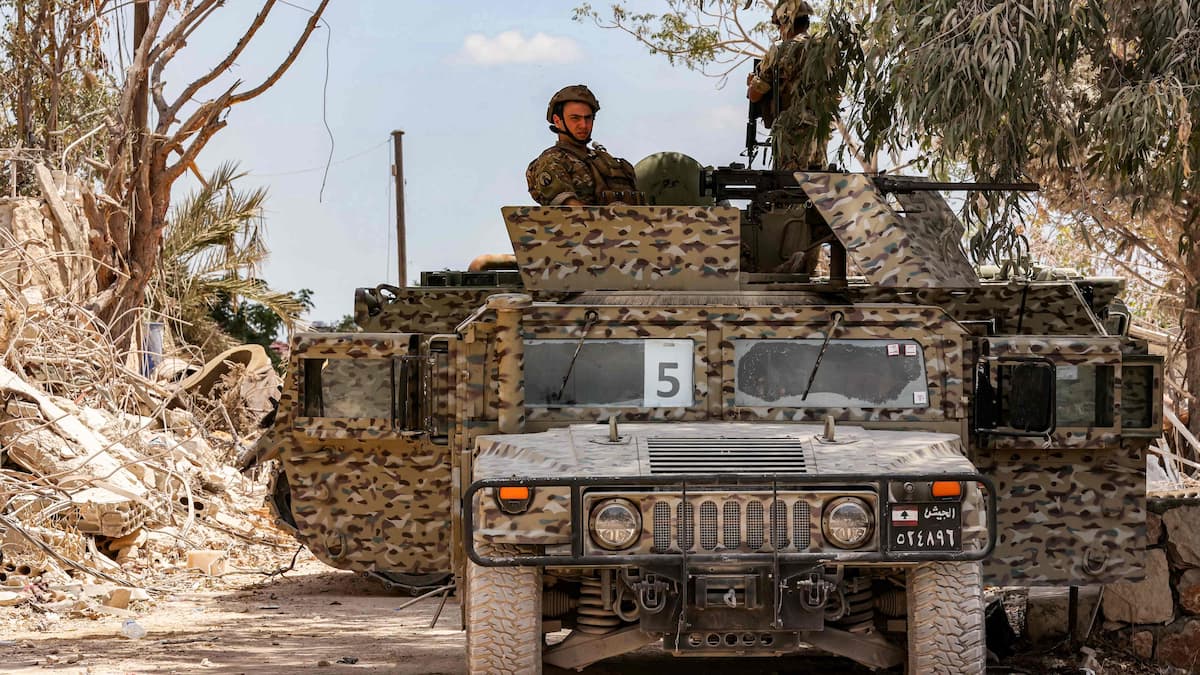

The Lebanese army condemned on Sunday the continuation of Israel’s military operations in southern Lebanon, which it says prevents it from deploying there as planned by the agreement signed in June between the two countries in Washington to end the war.
“The Israeli occupation forces continue their attacks and violations of the agreement and international laws by systematically destroying and bulldozing homes, bombing and raking with automatic weapons several areas in the south of the country,” the army said in a statement.
The Lebanese army began its deployment at the beginning of the week in the locality of Zawtar al-Gharbiya, but the fragility of the situation quickly became apparent: it accused the Israeli forces of having “opened fire near its positions” in this sector, as well as in “Kfar Tibnit and Nabatiyé al-Fawqa”, which “prevents it from carrying out its missions”.
Israel, for its part, spoke of “warning shots in the air”, justified by the entry of Lebanese soldiers into a sector which “was not part of the pilot zone”.
On Sunday, an AFP correspondent was able to see the extent of the destruction in the village of Zawtar al-Gharbiya, where Lebanese soldiers were patrolling while residents inspected the state of their homes.
“When I entered my house, I felt sadness. The destruction hurts me,” testified Ihsan Yaghi, a resident of the village, who found walls blackened by the flames and rooms covered with debris and rubble.
“We stand in solidarity with the Lebanese army,” she added, affirming her desire to “rebuild.” “We want to feel safe, it’s time for the state to take care of us, we are tired. »
In its press release, the army specifies that its soldiers “continue to support the return of the inhabitants” of the village.
The agreement signed in June provides for the deployment of the Lebanese army in “pilot areas” evacuated by Israel, which still occupies part of the south of the country, on condition of disarmament of pro-Iranian Hezbollah.
Despite a relative calm on the front, the Israeli army continues occasional strikes in the south of the country.
The Shiite formation, hostile to this agreement and refusing any disarmament, dragged Lebanon into the regional conflict on March 2 by attacking Israel, in support of Iran.
Israel responded with a vast bombing campaign and a ground offensive, which caused more than 4,300 deaths and more than a million displaced people, according to Lebanese authorities.
Received Tuesday at the White House by his American counterpart Donald Trump, Lebanese President Joseph Aoun reaffirmed the need for a “total withdrawal” by Israel to allow progress in the implementation of the framework agreement concluded last month.