
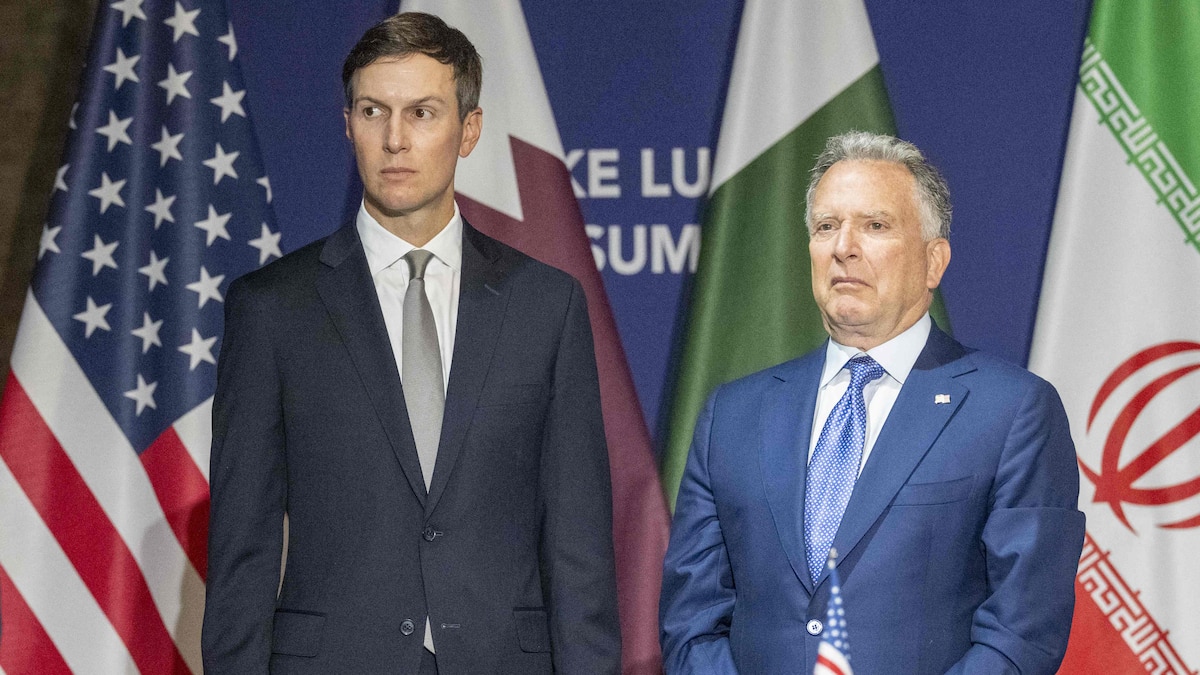

American and Iranian representatives are holding indirect technical discussions in Doha on Wednesday as part of negotiations aimed at a lasting settlement of the war in the Middle East, according to a diplomat, after exchanges of strikes which threatened to shatter the truce.
• Also read: No direct Iran/United States negotiation in Doha, according to Qatar
• Also read: Negotiations between Iran and the United States will begin in Switzerland
Washington and Tehran have been engaged since mid-June in negotiations supposed to last 60 days, a renewable period, with a view to a final agreement after the signing of a memorandum of understanding on June 17, under the mediation of Pakistan and Qatar.
But Tehran refuses any direct exchange at this stage.
The diplomat familiar with the discussions who had announced the holding of these talks to AFP – specifying, on condition of anonymity, that Donald Trump’s emissaries, Steve Witkoff and Jared Kushner, would not participate – then indicated that they were underway.
MM. Witkoff and Kushner met Tuesday in Doha with the Qatari Prime Minister who is also head of diplomacy, Mohammed bin Abderrahmane Al-Thani, with whom they discussed “ongoing talks between the United States and Iran”, as well as the situation in Lebanon, according to the emirate’s Ministry of Foreign Affairs.
After initially denying any meeting, Iranian diplomacy confirmed on Monday the sending of a “delegation of experts” to Doha, led by Deputy Foreign Minister Kazem Gharibabadi but excluded, “in the coming days” any negotiation “with the American side, at any level”.
Donald Trump, for his part, said at the start of the week that Iran had requested a meeting with the United States.
If the signing of the pact between Washington and Tehran made it possible to reduce the intensity of the conflict, significant tensions persist in particular around Iranian nuclear power, the release of frozen Iranian assets or the management of the strategic Strait of Hormuz, where traffic slowed this weekend after two ship attacks.
“Overall positive message”
Iran has been repeating for weeks that it wants to impose a right of passage in one form or another, a measure deemed unacceptable by the United States.
Unions and employers in the maritime sector will continue to consider the Strait of Hormuz as a war zone at least until July 9, they said in a joint statement on Wednesday.
In this context of uncertainties, the price of Brent, the benchmark for the global oil market, remained stable on Wednesday, a little above US$70.
Accusing Tehran of having targeted two ships last week, the United States bombed the country on Sunday. In response, Iran targeted two of its Gulf neighbors, Kuwait and Bahrain.
The situation since then seems to have calmed down on a military level.
“When a war of this magnitude comes to an end (…) it is inevitable that there will be implementation difficulties, incidents and differences of opinion,” noted the main Iranian negotiator, Mohammad Bagher Ghalibaf, during an interview broadcast Tuesday evening on state television.
According to him, Iran intends to focus current negotiations on the implementation of the clauses of the memorandum of understanding relating to the end of hostilities in Lebanon and the Strait of Hormuz.
It is still “very early in the negotiation process and battles are taking place behind the scenes as well as in the public square”, but “the overall positive message is that they continue to dialogue after last week’s clashes”, said Anna Jacobs, a non-resident researcher at the Arab Gulf States Institute, for AFP.
The two parties “send very different public messages”, maintaining a “lack of transparency” around the discussions, notes HA Hellyer, analyst at the Royal United Services Institute in London.
“Leave here”
In Lebanon, which Tehran has demanded to be included in talks with the United States, Israel has continued its strikes in recent days, despite the signing on Friday in Washington of a framework agreement between the two countries for a “lasting peace”.
The text conditions an Israeli withdrawal from southern Lebanon – where its troops entered at the start of the new conflict with Hezbollah supported by Iran – on the disarmament of the Shiite movement, which refuses to do so.
The Lebanese government is struggling to implement this long-standing requirement, despite pressure from the United States.
Israeli Defense Minister Israel Katz said Wednesday that the Israeli army would remain “indefinitely” in what it describes as “safe zones” in Lebanon, Syria and the Gaza Strip.
“We say to Iran as well as to Hezbollah: leave here, you no longer have your place here. There are two sovereign states that want to live in peace,” said Prime Minister Benjamin Netanyahu during a trip Tuesday to the part of southern Lebanon occupied by his country.
Lebanon was drawn into the conflict on March 2, when Hezbollah carried out fire on northern Israel in support of Iran, targeted by the American-Israeli offensive. Israeli bombings and operations have since left more than 4,200 dead, according to Beirut.