

A young German of Lebanese origin was killed by the police on Sunday evening in Berlin, according to the authorities who consider him to be the author of the car-ramming and stabbing attack the day before on the sidelines of the gay pridewhich left one dead and around thirty injured.
• Also read: Pride parade in Germany: one dead and 16 injured, hit by a vehicle
• Also read: Attack on Berlin Pride parade: suspect believed to be a supporter of jihadist group IS
• Also read: Search for suspect in deadly Berlin Pride parade attack
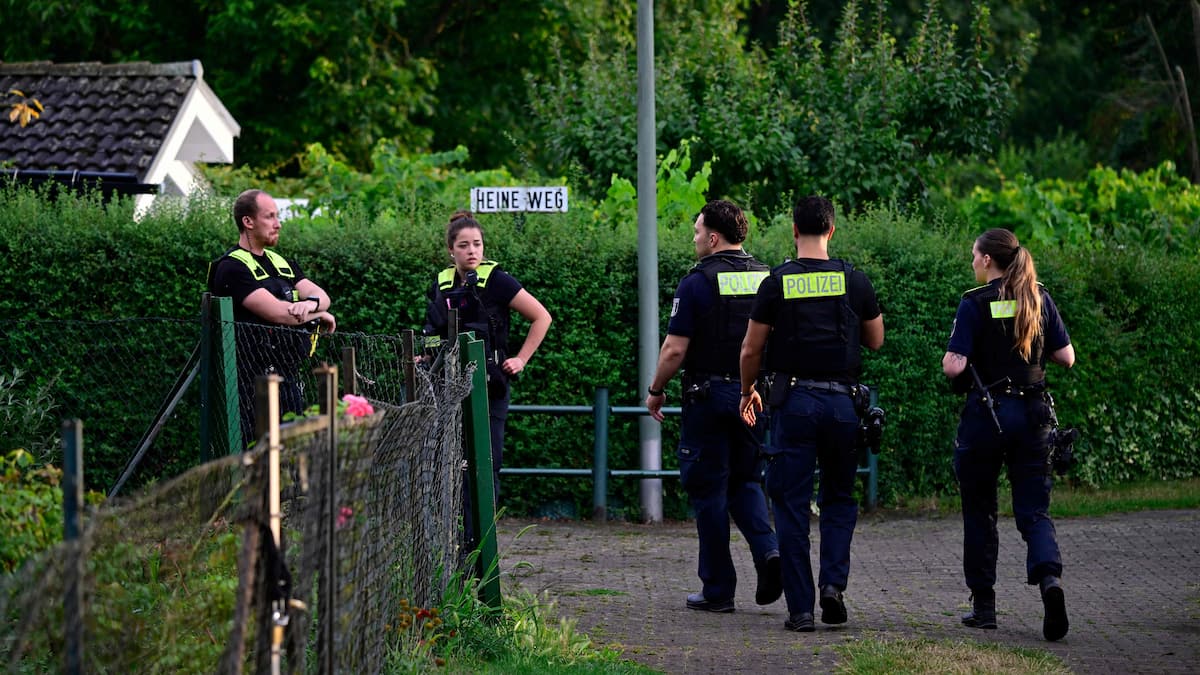
Police officers equipped with automatic weapons are seen on July 26, 2026 in a group of allotments in the Spandau district in western Berlin, near where the main suspect in the deadly attack that occurred the day before near the pride march was shot dead.
AFP
“According to the information we have at this stage (the suspect) would have run towards our intervention forces armed with a bladed weapon.” Members of the “SEK-Berlin” special unit then used their firearms, Berlin police reported on X.
Despite the intervention of firefighters, “the man died at the scene,” according to police.
The operation took place in a allotment garden in the Spandau district of Berlin.
At around 6 p.m., the suspect in yesterday’s attack in the Großer Tiergarten was located in an allotment garden in #Spandau. According to current findings, he is said to have run towards our emergency services with a stabbing weapon, which resulted in a police… pic.twitter.com/ncslEZom7N
— Berlin Police (@polizeiberlin) July 26, 2026
“Around 6 p.m., the suspect in yesterday’s attack in the Großer Tiergarten was located in a group of allotments in #Spandau. According to the information we currently have, he rushed towards our intervention forces with a bladed weapon, which led our SEK Berlin to use his firearms. Despite the immediate resuscitation measures implemented by the Berlin firefighters, he died on the spot,” we can read on the Berlin police account X.
Earlier, German Interior Minister Alexander Dobrindt revised the death toll upwards to 29 injured, compared to 16 previously.
The deceased victim is a woman. While the day before, firefighters had reported 3 emergency injuries, no one anymore seems to be “in danger of death”, announced Chancellor Friedrich Merz during a religious service at St. Mary’s Church in Berlin.
The suspect, whose name the minister revealed, Abdul Ballout, was a 21-year-old “German citizen of Lebanese origin” with a criminal record including “radicalization and membership in the Islamist milieu,” added Mr. Dobrindt, before the announcement of the death of the alleged sympathizer of the Islamic State (IS) jihadist group.
Late Sunday, the prosecution traced in a press release the legal journey of the suspect, convicted in May for trying to join IS in Syria via Lebanon, where he was arrested, convicted and returned to Germany.
If Abdul Ballout was sentenced to a custodial sentence, but not imprisoned, it is because his six months of pre-trial detention in Germany and his three months of detention in Lebanon were taken into account, as well as the fact of having admitted the facts, explains the prosecution.
The attack took place on Saturday around 10 p.m. (8 p.m. GMT) in the Tiergarten park, a few hundred meters from the Brandenburg Gate, the main gathering place on the evening of the pride march, called Christopher Street Day (CSD) in Germany.
Machete
The incident cut short a day of celebration for hundreds of thousands of people.
According to police, a white vehicle drove into passers-by before hitting a tree. Registered in Berlin, this Citroën minivan was visible on site on Sunday morning. Heavily damaged after hitting a tree, it was towed by investigators.
The suspect “then rushed at other passers-by, armed with a bladed weapon (…) – probably a machete – and also seriously injured them,” described Alexander Dobrindt.
On Sunday, the police no longer mentioned the hypothesis of an attack involving several perpetrators as the day before.
The police had launched a call for witnesses, accompanied by a photo and a physical description of the suspect: thin, approximately 1.90 meters tall, with black hair and wearing a black hooded sweatshirt and white pants.
“These acts have only one goal: to divide our society,” Chancellor Friedrich Merz reacted on Sunday, before attending the religious service honoring the victims.
Invited by members of the LGBTQ community to a vigil in front of the Brandenburg Gate early Sunday afternoon, hundreds of people observed a minute of silence.
Bad memories
This attack revived the memory of a series of similar acts which shook Germany in recent years, fueling the debate on immigration, several of the perpetrators being of foreign origin.
The deadliest attack in recent years was that in December 2016 against a Christmas market in Berlin by a Tunisian with jihadist motivations. It left 13 dead.
The period preceding the 2025 legislative elections was also marked by a wave of attacks in public places, notably perpetrated by Islamist attackers.
These attacks gave rise to the far-right Alternative for Germany (AfD), which has become the leading opposition force and which is now ahead of Mr. Merz’s right in voting intentions.
On Sunday, an AfD MP, Martin Hess, estimated that the gay pride attack “reveals once again the total failure of those responsible in matters of security” and immigration.
Met in the Tiergarten where he came to pay tribute to the victims, Armin Dünhölter, 49, a drag queen who has been officiating “for years” at German gay prides, says he is “in shock”.
“With the incidents of recent years, we have obviously often said to ourselves that, sooner or later, one of our demonstrations could be targeted.”