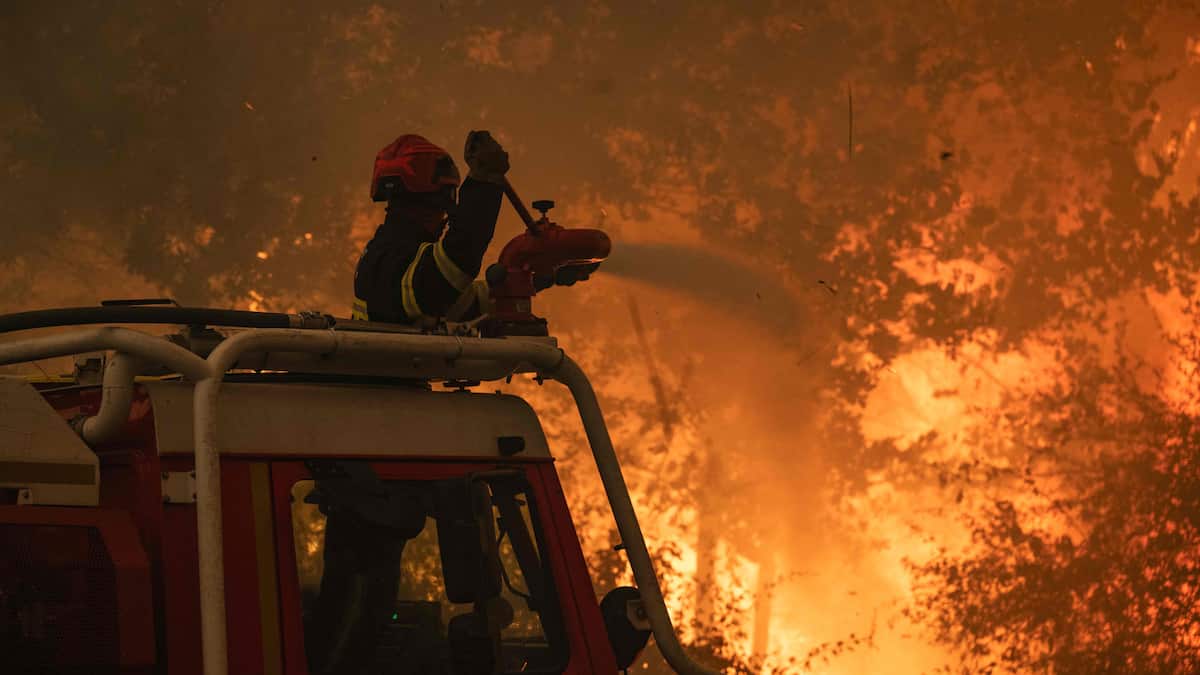


For decades, the Landes forest has still borne the scar of the deadliest fire in its history. Every summer marked by extreme temperatures, the same worry resurfaces: seeing the tragic scenario of 1949 repeat itself. A fear that is rekindled by the fire in the Landes de Gascogne massif, in Gironde, once again ravaged by the flames which continue to rage this Monday, July 27.
Composed largely of maritime pines, this forest is particularly vulnerable: their highly flammable resin transforms the trees into a formidable fuel when drought sets in. Under these conditions, a simple fire can quickly become uncontrollable.
This is what happened in the summer of 1949. That year, more than 80 people died in the flames, making this fire the deadliest ever recorded in France. Declared on August 19 near the town of Saucats, in Gironde, the fire then spread at lightning speed due to dried-out vegetation after several particularly hot summers. At the end of the Second World War, the forest also suffered from a lack of maintenance, which favored the spread of flames.
Sudden wind changes
The blaze quickly spread to the neighboring town of Cestas, before reaching Barp, Marcheprime and Mios. To fight against its spread, emergency services at the time had meager resources. They set up counterfires, which consist of deliberately burning certain areas to slow down or even stop the flames. But all these attempts remain in vain.
The situation becomes even more complicated with sudden changes in the wind. First oriented towards the northeast, it turns suddenly and pushes the flames towards the west, making them advance at a speed of 4 kilometers per hour. On August 20, while residents believed there was a calm, a new shift in the wind caused embers to flare up again, which the emergency services had thought were extinguished. Flames reaching nearly 200 meters high then devoured the forest. That day, 82 people lost their lives, trapped by a fire that went out of control. Among the victims are water and forestry agents, volunteers, the mayor of Saucats, as well as several soldiers.
The scale of the disaster requires exceptional mobilization. In addition to the residents and firefighters of Paris, British teams from the Royal Air Force came to reinforce those mobilized. After six days of fierce fighting, the main outbreaks were finally brought under control on August 25. The fire leaves behind a devastated landscape: an immense cloud of smoke obscures the sky, visible more than 100 kilometers away, dozens of farms have gone up in smoke, while the disaster areas, more than 50,000 hectares of forest, are nothing more than fields of ashes.
National mourning
The whole of France is devastated by this tragedy. A day of national mourning, called “red mourning”, is declared on August 24. A few days later, the funeral of the victims, celebrated by the Archbishop of Bordeaux Mgr Maurice Feltin, brought together many people affected by the event.
To prevent such a tragedy from happening again, the Landes massif is gradually equipping itself with a vast defense system against fires. Thousands of kilometers of forest trails now allow firefighters to quickly access fires, watchtowers make it easier to detect fires, water points are installed and firebreaks are created to slow the progression of the flames.
These measures, which until then appeared effective, showed their limits during the last major fires which affected the Gironde, in 2022 and again in 2026. If this year the fire covered 42,000 hectares according to the latest report, the fire still in progress could well equal or even exceed the record of 50,000 hectares burned held by the summer of 1949. But the human toll remains much lower: injuries, certainly, but no deaths have been reported at this time.