Smoke from wildfires raging in remote areas of Ontario spread toward the northeastern United States and New York on Thursday, exposing millions of people to severely degraded air quality.
• Also read: Poor air quality: Toronto rises to 2nd place in the world with a “dangerous” index
• Also read: “They are suffocating, they are surrounded”: outfitter appeals for help for canoeists trapped in Ontario forest fires
• Also read: Forest fires in Ontario: air quality could deteriorate in Quebec
After images of Toronto plunged into an apocalyptic yellow atmosphere on Wednesday, it is now the states of Minnesota, Wisconsin, Michigan and Illinois, bordering Canada, which are particularly affected, and New York should follow in the afternoon.
According to data collected by the company IQAir, Toronto was still the second most polluted metropolis in the world on Thursday morning, behind Detroit, after having been the most polluted for much of the day before. Minneapolis and Chicago are also at the top of this ranking.
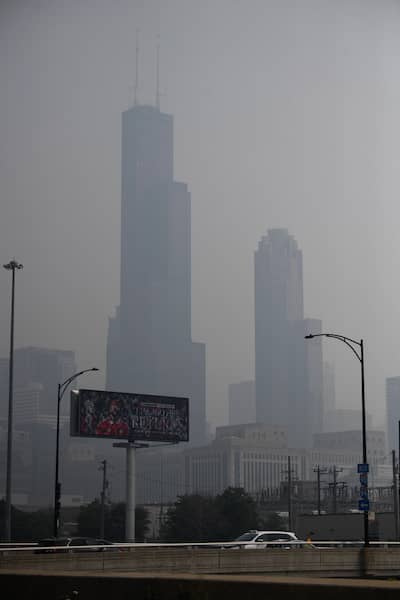
AFP
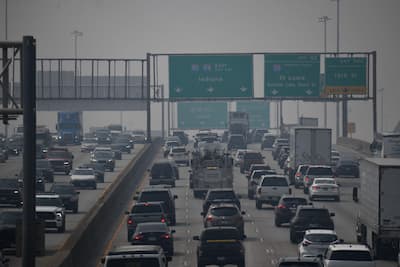
The air in the New York region will reach a threshold described as “dangerous for health” due to fine particles from the fires, warn the authorities, who encourage residents to spend as much time as possible indoors.
“This could constitute the worst smoke event in New York since 2023, and the situation will be closely monitored,” stressed the municipality. Masks are distributed in libraries and train stations.
By 2023, the city’s sky had taken on an orange hue that left its mark on residents, and the air quality index had reached a dangerous level of 465.
A value already exceeded Thursday in Detroit, around 600, according to the monitoring tool of the American Environmental Protection Agency (EPA), after having climbed even higher during the night.
AFP
Localities evacuated in Canada
These poor conditions are expected to continue until at least Friday, warn authorities in the US state of Michigan, located south of Ontario.
In the northwest of this Canadian province, authorities count more than 130 active uncontrolled fires, including 63 out of control. The affected areas are immense – just one has already affected nearly 300,000 hectares – and are starting to hit inhabited areas.
The Ontario authorities formally requested additional assistance from the Canadian federal government on Thursday, particularly in terms of air resources for evacuations of remote communities.
“More than 150 fire crews are working around the clock to protect residents from fires,” Ontario Premier Doug Ford said on the social network X on Thursday.
Although no damage report has yet been communicated, two new localities were evacuated on Wednesday evening in the province, adding to the ten or so evacuations already ordered.
According to the latest official Canadian statistics, the forest fire season has so far been much less dramatic in the country than in 2023, a record year, and 2025.
But on this immense territory, 1.9 million hectares have already burned this year, an area approaching that of Slovenia.