
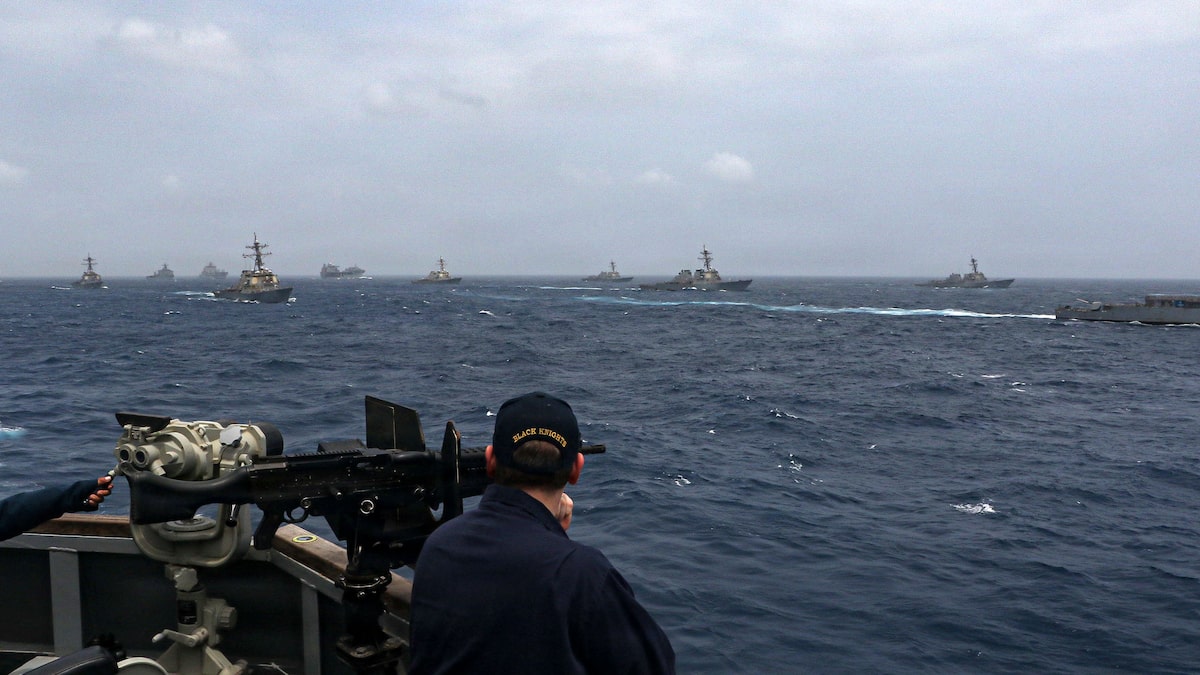

The pace of strikes does not slow down between the United States and Iran, more than a week after the resumption of hostilities around the strategic Strait of Hormuz, and despite calls on Thursday from the Pakistani mediator to resume dialogue.
• Also read: The war between Iran and the United States takes hold, Hormuz almost paralyzed
• Also read: New round of strikes: Trump believes that an agreement with Iran is still “possible”
“The attacks continue and they are so violent that my hands are shaking,” Hani, a 34-year-old Iranian professor living in the town of Ahvaz (southwest), told AFP. “There were at least 11 or 12 explosions. I feel like my ears are going to explode.”
In the last 24 hours, the United States has launched two new bombing salvos on Iran, which responded by targeting countries in the region allied with Washington – in a scenario that has been repeated identically for several days.
And as at the height of the war, warnings are coming from both sides: if the oil and gas installations in the Gulf have so far been spared, Tehran has threatened to destroy infrastructure in the Middle East if its own were attacked.
US President Donald Trump said on Tuesday that he would strike the country’s bridges and power plants if the Iranians did not return to the negotiating table.
Clashes resumed on July 7 after attacks on ships in the Gulf, blamed on Iran. The strikes since then are unprecedented since the April ceasefire, undermining diplomatic efforts to bring a lasting end to the conflict.
Triggered on February 28 by Israeli-American bombings, it left thousands dead, mainly in Iran and Lebanon, and continues to shake the world economy.
Pakistan, mediator of the discussions, urged the two parties on Thursday to “end the violence and resume discussions” within the framework of the memorandum of understanding signed in mid-June, which has now been shattered.
And Islamabad called for a “return to normal in the Strait of Hormuz”, again blocked by Iran last weekend. In response, the United States reinstated its blockade of Iranian ports on Tuesday evening.
Hospital evacuated
In the strait, through which a fifth of the world’s oil and liquefied gas (LNG) transited before the war, traffic has become rare, with only thirteen commercial ships recorded on Tuesday by the maritime monitoring company Kpler.
Oil prices continued to tread water on Thursday after the surge at the start of the week, with a barrel of Brent hovering around $85.
The American army claims to have struck military targets “used to threaten ships transiting freely through the Strait of Hormuz”.
But Iran accuses Washington of having also targeted civilian infrastructure, such as Semnan airport, 250 km from the capital. A hospital in Ahvaz (southwest) was also evacuated following American strikes in the surrounding area, according to the authorities who denounced a “barbaric attack”.
Explosions were also heard in several coastal towns including Bandar Abbas and Chabahar, as well as on the island of Qeshm, state media reported.
“We don’t live, we survive. May God end the war, then the economic difficulties,” prays Nadin, a 27-year-old teacher who lives in the province of Sistan-Baluchistan (south-east).
In Tehran, spared until now from the bombings, life goes on as it does and residents are monitoring the latest developments without perceptible concern, despite the activation last night of anti-aircraft defense systems on the outskirts.
More than thirty civilians have died since the clashes resumed, according to the latest report from the Iranian authorities, who also reported the deaths of seven soldiers.
“Who will be next? »
Iran responded by targeting Bahrain, Kuwait and Jordan with drones. “Every day, I wake up wondering if the situation will calm down or get worse,” Moustafa Mohammed, a 39-year-old Sudanese accountant living in Kuwait, told AFP. “Uncertainty grips everyone.”
The war has also spread to Iraq, where the prime minister condemned a “drone attack” near the American consulate in Erbil, in the Kurdistan region, the first in the area since the April truce.
In Tehran, after a banner displayed in the center showing the American president in a coffin, a large red sign proclaims, in English, “Who will be next? » (who is D nexT one?) with the “D”, stylized to represent the president’s famous blond locks, and the “T” – Donald Trump’s initials – in capital letters.
Below is the hashtag #lindseygraham, named after the Republican senator who died on July 11, supporting the Israeli-American offensive against Iran.


