
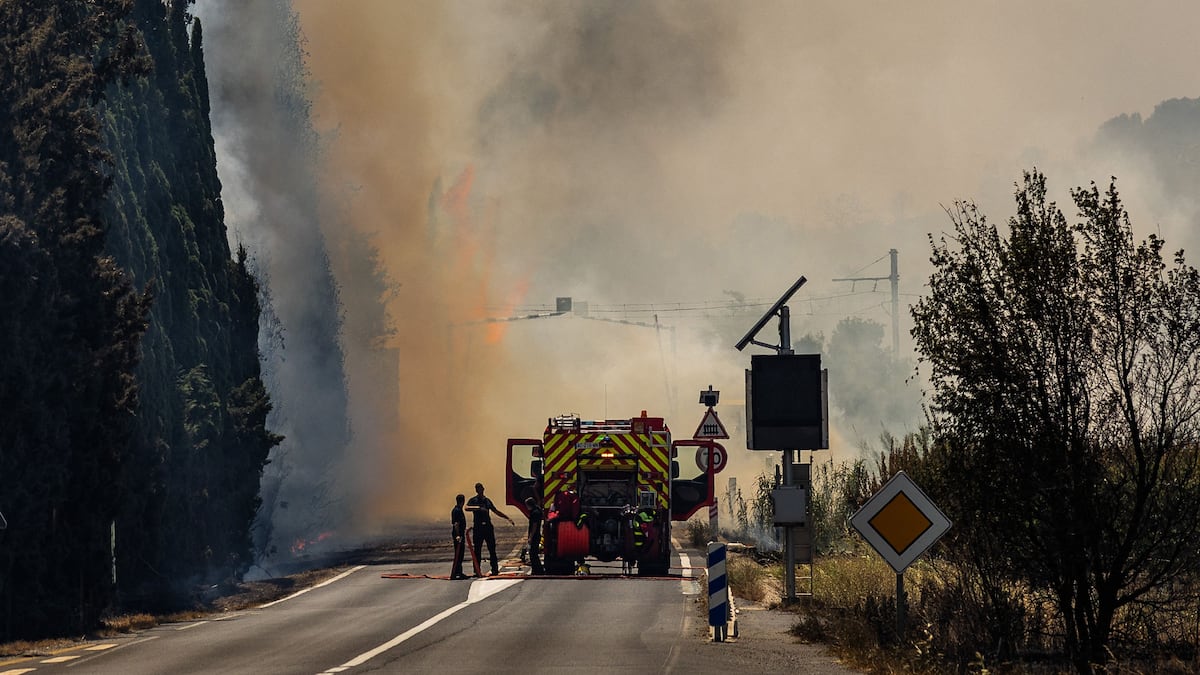

Hundreds of firefighters assisted by water bomber planes fought the fires on Monday in France, but also in Spain and Portugal where the flames ravaged thousands of hectares, fueled by a new wave of intense heat which is taking hold on the continent.
In France, the fire which broke out on Saturday evening in the Pyrénées-Orientales (south) has already devoured 4,900 hectares of woods and scrubland, dozens of buildings and led to the evacuation of 10,000 people while disrupting the Tour de France, according to the authorities.
The fire “is fortunately stabilized in a certain number of places, but it is not completely fixed”, declared the French Minister of the Interior, Laurent Nunez on the spot, referring to a report of 11 minor injuries, including seven firefighters.

AFP
Seven hundred firefighters, who must receive support from six planes from other European countries, are mobilized to try, despite the wind, drought and extreme heat, to contain this fire which has spread to the Aspres massif, arid and difficult to access.
“In some places, it looks like we have received an atomic bomb, it’s catastrophic,” Marc Bianchini, the mayor of Rodès, a village evacuated on Sunday evening, told AFP by telephone.
“At 7 a.m., it seemed out, then with the heat and a gust of wind, it started again,” he explained, specifying that around twenty homes and around thirty vehicles had burned in the territory of his commune.
Fifty buildings were damaged by the flames to varying degrees in the area, according to the Pyrénées-Orientales prefecture.
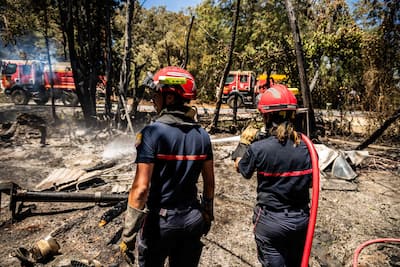
AFP
The Tour de France cyclists, who left from Granollers (Spain), completed their 3rd stage practically without an audience on the French side, as requested by the prefecture so as not to mobilize the firefighters or hinder the movement of emergency services.
Multiple fires are raging elsewhere in the south of France, while intense heat, exceeding 40°C locally, spreads across the country for a third heatwave episode in less than two months. At the hottest of the day, 40.8°C was recorded in Moules-et-Baucels (Hérault, south).
The heat will “gain ground towards the north and east” on Tuesday, according to Météo-France which has extended “orange” vigilance to 61 departments, from Finistère (west) to Savoie (east) via Paris.
In Spain, the heat wave which is particularly severe in the south and north is expected to last “at least until Wednesday”, the National Meteorological Agency (Aemet) said on Monday.
43°C
At the end of June, a heat wave suffocated hundreds of millions of people in Europe. In France, this month was the hottest ever known, after an already unprecedented first heatwave in May.
In Spain, temperatures reached 43°C in places on Sunday in Andalusia (south) and Extremadura (southwest).
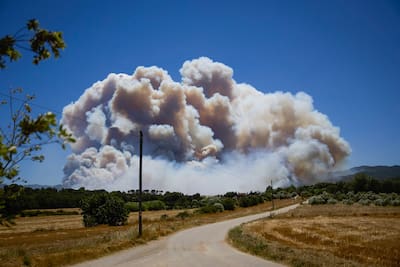
In Catalonia (north-east), a forest fire near Girona remains under close surveillance by firefighters, after the smoke began to threaten the tourist beaches of the Costa Brava on Friday and reached the island of Mallorca, located more than 250 km away.
AFP
During the night from Sunday to Monday, firefighters continued their work within a perimeter of more than 40 kilometers to control possible resurgence of the flames.
In neighboring Portugal, a vast forest fire has ravaged at least 13,000 hectares of vegetation in Vouzela (north) according to the latest report from the authorities. The fire was “being resolved without risk of spreading” on Monday morning, the National Civil Protection Authority said on its website.
Most fire outbreaks are of human origin, according to firefighters, but their development is favored by the increase in heat waves and drought under the effect of climate change.
In 2025, the areas ravaged in Europe by forest fires will reach a record figure of 1,034,550 hectares.
Repeated heatwaves are an unequivocal marker of climate change, caused mainly by the burning of fossil fuels by humans.