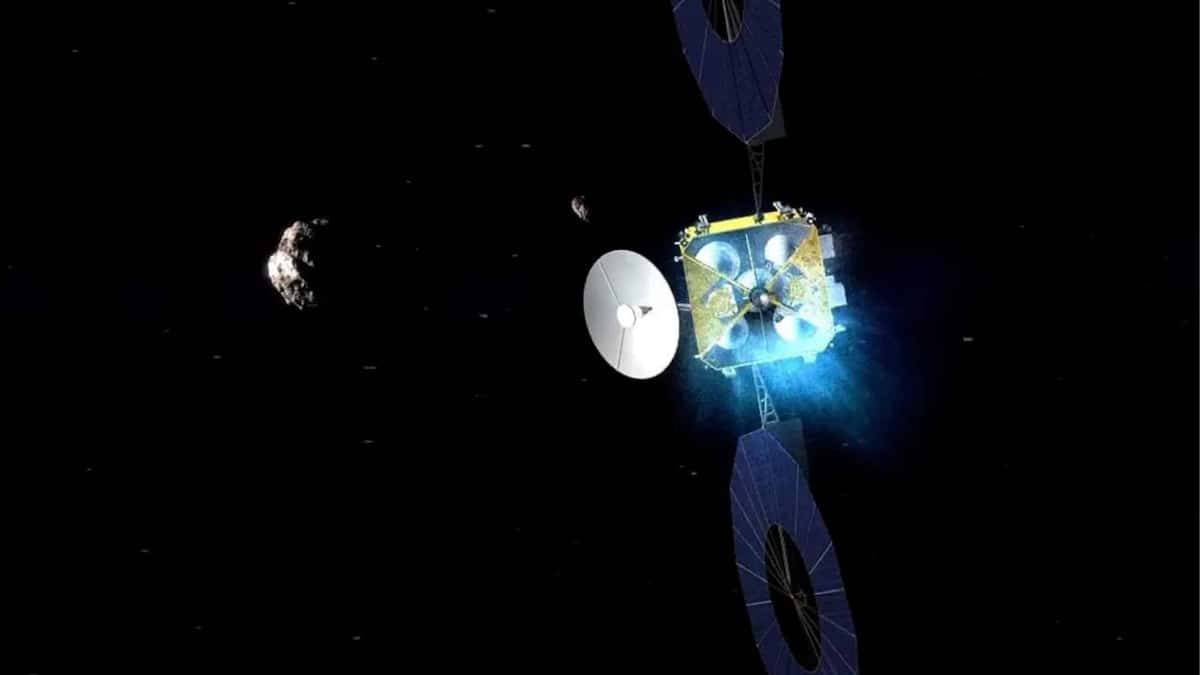

The Tianwen-2 probe, which is to bring samples from an asteroid back to Earth, has begun its scientific exploration near its target after a journey of a billion kilometers, the Chinese space agency said on Monday.
Asteroids are rocky bodies orbiting the Sun. Scientists believe samples could hold clues to the beginnings and evolution of the solar system.
China launched its Tianwen-2 probe (“Questions in the Sky-2”) on May 29, 2025. This is its first mission to collect samples from an asteroid. The one that was targeted is named “2016 HO3”.
“After some 400 days and a journey of around a billion kilometers” the probe recently “reached 20 kilometers from the asteroid and began its scientific exploration,” explained the Chinese space agency CNSA in a press release.
She publishes a photo taken by Tianwen-2 of 2016 HO3, a gray rock mass with a rugged appearance, which stands out against the black background of space.
“The probe will now gradually carry out more detailed scientific exploration to acquire data on the morphology, material composition and internal structure of the asteroid, in order to lay the foundations for future sample collection,” detailed the CNSA.
Once the collection is complete, Tianwen-2 must take off again then release a module from space which will return alone to Earth with the precious samples.
Recovering asteroid samples is not new: Japanese and American missions have already accomplished this feat.
Technologically, however, Tianwen-2 marks an important step for China in terms of catching up with the United States and Europe in the field of deep space exploration, beyond the Moon, according to experts.
China has already sent probes to collect samples in the past. It thus brought back to Earth in 2024 samples of the far side of the Moon – a world first.
The country is investing billions of euros in its space program. In particular, it plans to send astronauts to the Moon by 2030.