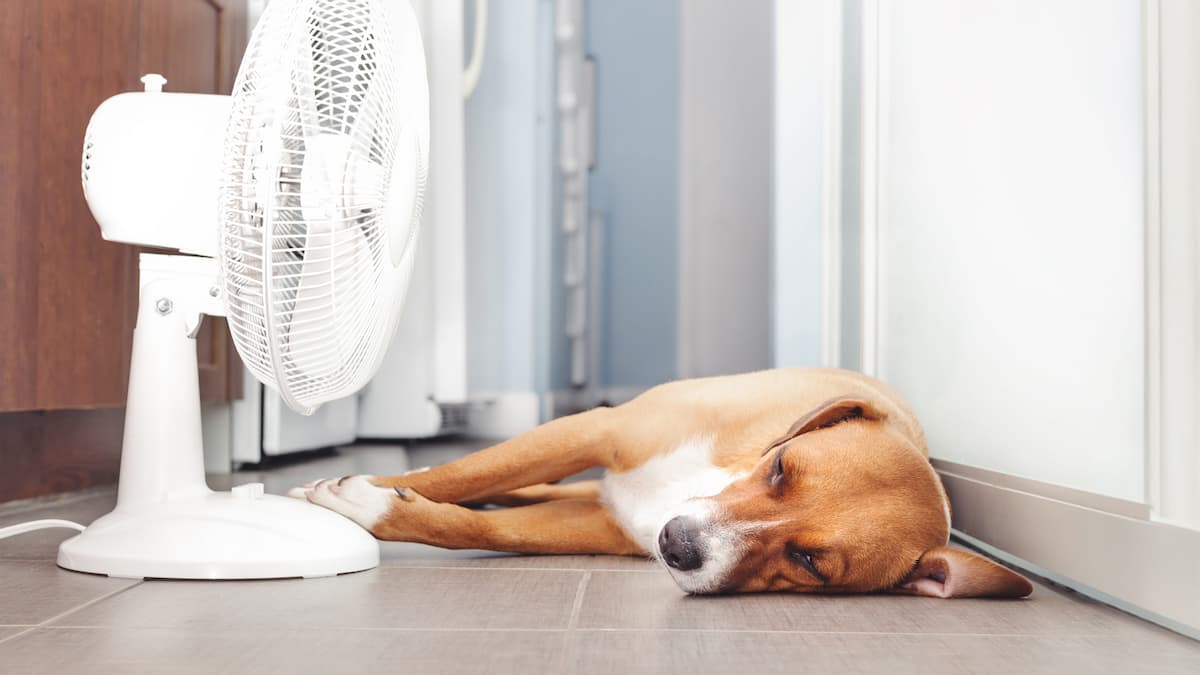

Cléo gasps, drinks little and gets angry. Signs that might seem almost harmless, but in the middle of a heatwave, it’s a race against time to avoid heatstroke which could be fatal to this young overweight cat.
• Also read: Heat wave: a 3-year-old child found dead in a car in the Paris suburbs
• Also read: How to help your pet during a heatwave
Urgently called to this apartment in the Paris region, veterinarian Rodolphe Lesauvage took her temperature, checked that there were no other pathologies, and gave her an infusion to quickly rehydrate her.
“If we had not intervened and explained to the lady the prevention for this type of cat, it was very likely that in the next 24 hours its temperature would continue to increase, its respiratory effort would continue to increase and that there would be complications,” explains this veterinarian from the Vetoadom service.
When the temperature becomes extreme, “we have organs that begin to no longer function well, to be damaged, we can have severe hemorrhagic diarrhea, abdominal hemorrhage, a heart attack…”, he explains.
Since the start of this historic heat wave in France and part of Europe, animals such as rabbits, horses and birds have been suffering during these heatwaves which are likely to be repeated with global warming.
At the veterinarian, consultations are increasing, especially for cats not usually prone to heat stroke. “For cats, it is long-term after several days of heat and progressive dehydration. For dogs, we see them especially the first two days, after which people take the right reflexes,” notes this veterinarian at home in Île-de-France, one of the nine French regions which experienced up to 40°C and beyond on Wednesday.
The dog is panting heavily, drooling, has pale gums, is disoriented… He is the victim of heatstroke which mainly happens in the car and when walking, especially in the city where the concrete can reach 60°C and burn the pads of his paws.
The emergency is to cool him in a cool place, wet his extremities then wrap his body in a damp towel and if the temperature does not drop, consult a veterinarian.
“Fatal in one in two cases”
Faced with Goldy, a 16-year-old cocker spaniel, Mr. Lesauvage places a catheter in her by hanging it on the lamp to rehydrate her, makes her take “a paw bath” in a glass of water at room temperature… “At home, I take what I can,” he smiles.
Despite this care, the vital prognosis is poor, the veterinarian suspects organ failure linked to the heatwave or a tumor: she is hospitalized.
But many animals die before even seeing a veterinarian. Puppies and kittens, obese or elderly animals, and those with a crushed nose (brachycephalic) are particularly susceptible. “In a quarter of an hour, a bulldog can die of heat stroke,” warns Mr. Lesauvage.
Between Wednesday evening and Thursday morning alone, the veterinary emergency number 3115, of which Vetoadom is a part, noted that “18.9% of animals taken in emergency died, mainly as a result of heatstroke”, which is “more than double the mortality rate usually observed”.
“Heat stroke is fatal in one in two cases,” explains Suzy Valentin, veterinarian in Versailles, near Paris.
This is what almost happened to the cat Chi, hospitalized two years ago. Her mistress was so frightened that she now reacts as soon as it gets too hot: shutters closed, water points in several rooms, cooling mats and wet food for her cats.
When Chi started breathing very quickly, she wet her paws and head with a washcloth and placed her in the only air-conditioned room in the apartment: the living room.
Thanks to these good reflexes, the cat regained her body temperature, which the veterinarian noted upon his arrival.
Proof that the majority of cases occur due to “a lack of prevention”. “I worked in Corsica,” explains Mr. Lesauvage, and on this Mediterranean island “it was very, very rare to treat an animal for heatstroke, they were used to it. »