
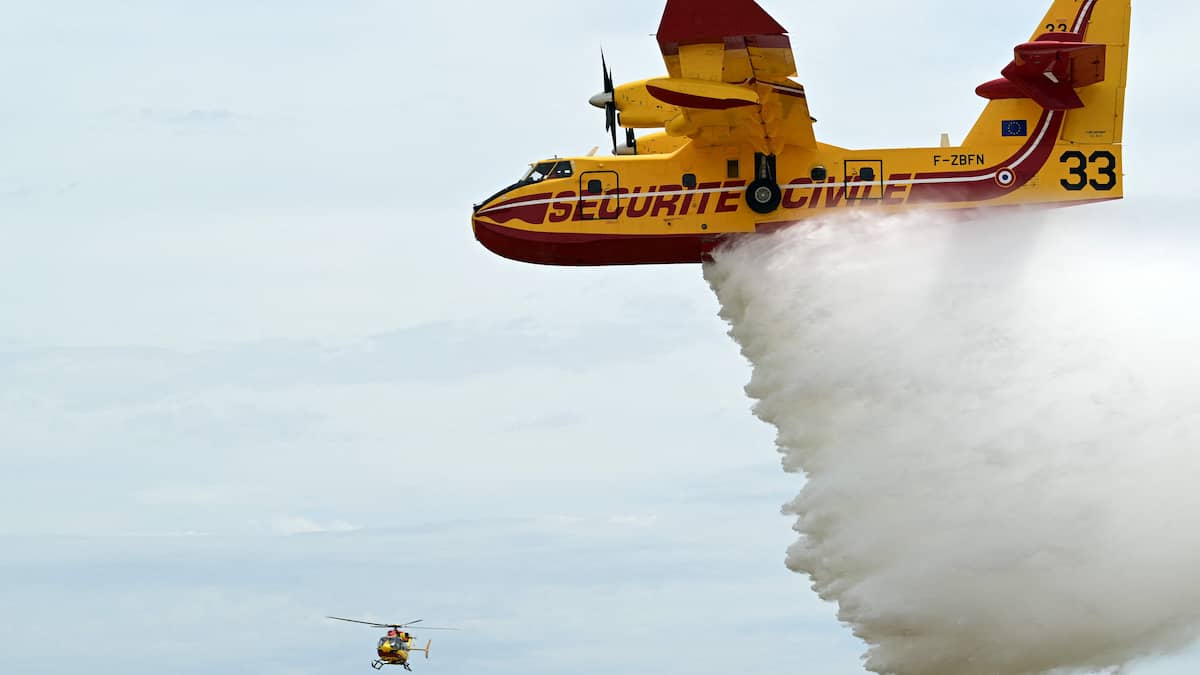

In the factory where future Canadairs are assembled, the flags of France and other European states, which enabled the rebirth of this iconic water bomber, hang above the production line.
Long awaited, particularly by France struggling with a megafire in Gironde (south-west), the first devices will however not be available before 2028.
Abandoned in 2015 by the Bombardier group, production was only relaunched in 2024 in Calgary by the Canadian company De Havilland, which bought the rights to this aircraft.
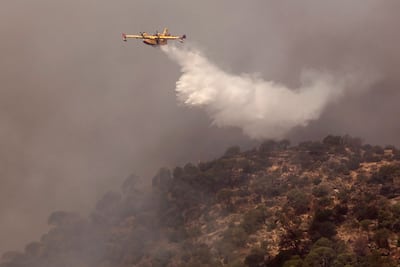
Capable of carrying more than 6,000 liters of water in just 12 seconds thanks to two scoops located under its fuselage, it has been a pillar of the fight against forest fires for decades.
AFP
On the industrial site, the fuselage and wings of the aircraft are assembled on a line which is far from robotic. “All the holes, all the rivets that you see on the fuselage were made” and installed “manually”, explains Victor Ocadiz, director of operations, to AFP.
The restart of Canadair production was made possible by a first order for 22 aircraft placed in 2024 by the EU, France, Spain, Italy, Greece, Portugal and Croatia, recalls Jean-Philippe Côté, head of strategy.
Intensifying wildfires across the world due to global warming have since increased the company’s order backlog to nearly 40 aircraft. But its production capacity is limited to around ten devices per year.
Controversy in France
In France, the question of the number of Canadairs available has taken a political turn. The executive is accused by opposition parties of having canceled an order for two aircraft in 2024 against a backdrop of budget cuts.
With an aging fleet of 12 Canadair CL-415s, France ordered two new generation DHC-515 aircraft in 2024, as part of the European order, then two others in June.
In Calgary, De Havilland assures that it can meet the schedule and “continues to increase the pace” to deliver its first aircraft on time, according to Jean-Philippe Côté.
“We have two planes to be delivered to France in 2028-2029 (…) and the two planes announced last month for 2032-2033,” he continues.
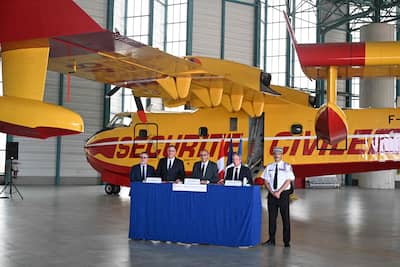
In June, French Interior Minister Laurent Nuñez mentioned April and November 2028 for the delivery of the first two planes and insisted on “respecting” the schedule.
AFP
Asked about the precise delivery months, a De Havilland spokesperson assured that they remained “in line with forecasts”, without giving further details.
More than 50,000 parts to produce
The first DHC-515, a modernized version of the CL-415, which will leave the assembly line will be “delivered at the beginning of 2028” to Greece, according to Mr. Côté.
For De Havilland, the biggest challenge in restarting production was getting the entire supply chain back on track, after almost a decade of interruption.
The group had to put “more than 50,000” different parts back into production, and “reselect new suppliers because the previous suppliers no longer existed,” explains the manager.
This also benefits, according to him, the 160 older generation Canadairs still in service around the world, half of which are in Europe and the other in North America. Devices sometimes more than 30 years old which have major maintenance needs.
“If a plane is damaged, we can quickly take a part from the production line and send it to France. It is increasingly easier for us to respond to repair needs, assures De Havilland’s head of strategy.