
Caught between persistent inflation caused by the war in the Middle East and Donald Trump’s desire to see rates fall, the American Federal Reserve (Fed) made the choice on Wednesday not to choose, by keeping its rates unchanged.
At the end of its traditional two-day meeting, the Monetary Policy Committee (FOMC) decided to maintain its rates in the range between 3.50% and 3.75%, for the fifth time in a row.
According to CME’s monitoring tool, FedWatch, about two-thirds of analysts had anticipated such a decision. But at the same time, a third of analysts were willing to bet on a rise in interest rates.
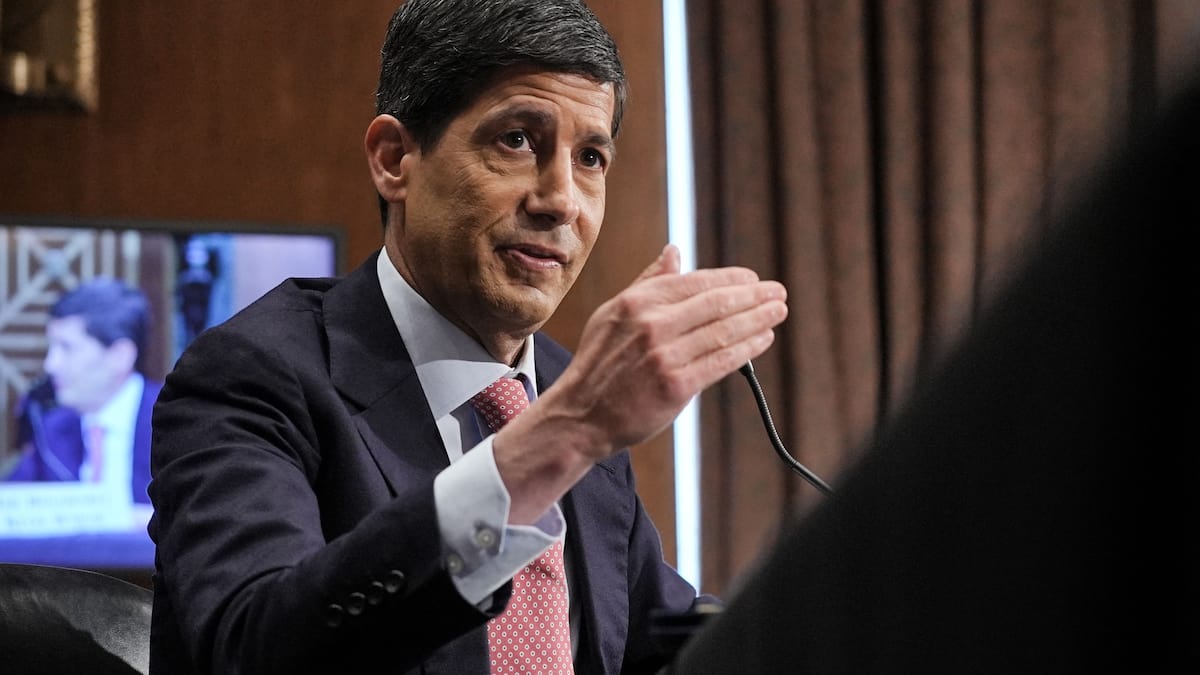
A significant part of divergent opinions among specialists, unprecedented the day before the decision, which was explained in particular by the desire of the new president of the Fed, Kevin Warsh, to no longer give any indication in advance on the direction that the central bank could take.
In his first public statements as president of the institution, Kevin Warsh reaffirmed that it would be focused on bringing stability to prices, without giving any indication as to the method envisaged.
An increase in rates, however, would have represented an unfavorable scenario for President Donald Trump, who has promised to bring down prices and borrowing costs. And the FOMC fiercely discussed the subject: three of its members even spoke out in favor of such a decision.
Anything but a surprise, several had affirmed that they were considering it, one of them, Christopher Waller, having estimated in mid-July that the Fed, should “be ready to tighten its monetary policy to avoid a repeat of the inflation episode of 2020-2021”, during the Covid-19 pandemic.
If Mr. Waller ultimately came out in favor of the status quo, this is not the case for his colleagues Beth Hammock, Lorie Logan and Neel Kashkari.
Before appointing Kevin Warsh – from whom he makes no secret of expecting a more accommodating monetary policy – Mr. Trump led a fierce campaign against the man who occupied his chair for eight years, Jerome Powell.
The American president maintained pressure on the central bank until the last moment, assuring Monday that “the report on inflation was very good”, with “costs falling rapidly”. Enough in his eyes to justify that “rates should be lowered”, he insisted again.
Temporary inflation
In reality, inflation has started to rise again in recent months, mainly due to the war in the Middle East following American and Israeli bombings in Iran.
In May, the PCE index, which is favored by the Fed to determine its monetary policy, reached 4.1%, 0.3 points higher than in April and up 1.2 points since February.
Since then, energy prices, the primary cause of the current inflation peak, have started to fall again. However, they remain at a much higher level than at the start of the year and very volatile depending on the evolution of hostilities.
June PCE data will be known on Thursday, the day after the Fed’s decision.
In the opinion of most analysts, the fact that inflation is linked to energy means that it can be seen as temporary, and should encourage the majority of FOMC voters to be patient.
Especially since the job market – the Fed’s other mandate – continues to show its strength. Unemployment remains low (4.2%) although this is partly explained by a drop in the labor force participation rate, to the lowest since the Covid pandemic.
Donald Trump is already ready to place the responsibility for a decision other than a rate cut on certain members of the FOMC, whom he considers “particularly politicized”. “I know what he (Kevin Warsh, Editor’s note) wants to do, but he needs the agreement of certain people who may have bad intentions,” the American president said on Monday.
More details to come…