
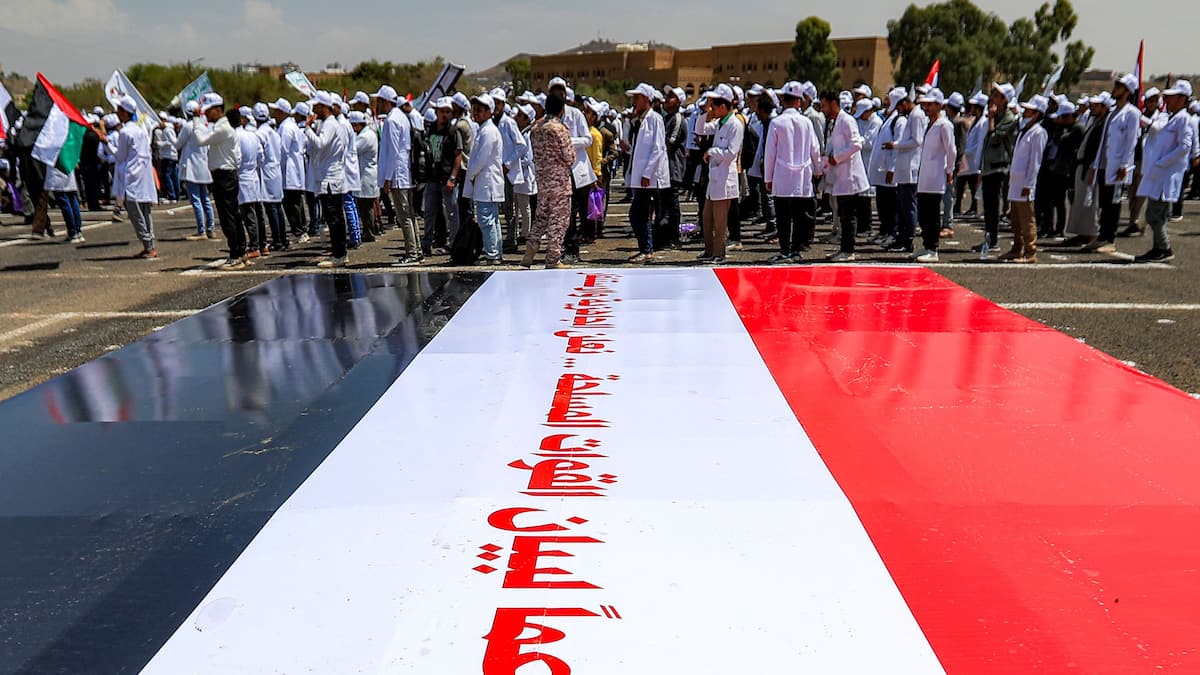

Iran vowed Thursday to continue its retaliation against the U.S. foe as long as it is attacked, while its Yemeni Houthi allies opened a second front in the regional war by claiming responsibility for attacks in the Red Sea on two Saudi oil tankers.
• Also read: Oil nears $100 after Red Sea attacks
• Also read: New tariff threat against Canada: “A tactic by Donald Trump to prepare to negotiate”, according to Magali Picard
• Also read: EU countries reach agreement on new sanctions against Russia
The clashes between Tehran and Washington, which resumed on July 7, raise fears of a lasting blockage of hydrocarbon exports while the Strait of Hormuz is blocked by Iran and the Yemeni rebels have announced a blockade of the fleet of Saudi Arabia, the world’s leading exporter of crude.
The result was a surge in oil prices: around 2:15 a.m., Brent, the international benchmark, was approaching $100 at $96.31 per barrel (+2.38%), far from the lull that followed the signing of an Iranian-American memorandum of understanding in mid-June.
After a twelfth consecutive night of hostilities, the Iranian army vowed that it would continue its “retaliation” “as long as American attacks against the country’s infrastructure and coastal areas continue.”
Tehran will continue “to pay a very heavy price”, declared the head of American diplomacy, Marco Rubio, on the sidelines of Asean in Manila, affirming that Iran was “clearly not ready to make an agreement”.
Tehran said it had notably struck, in Kuwait, ammunition depots and fuel tanks, and in Jordan, an American radar of the THAAD anti-missile system and a Patriot system, designed to intercept ballistic projectiles.
The Jordanian army reported ten missiles and drones fired towards the kingdom during these 24 hours, nine of which were intercepted, and the Kuwaiti army announced during the night that it was responding to “hostile drone” attacks.
Paralyzed sea lanes
On the American side, the army said it had targeted Iranian military targets, to “further reduce Iran’s ability to threaten civilian sailors and commercial ships” transiting the Strait of Hormuz, at the heart of the tensions.
Iranian media reported strikes twice on Bushehr, the city where the only operating nuclear power plant is located, and in Chalamcheh, near a border crossing with Iraq, where two people were killed.
Other bombings were reported in Ahvaz, near the Gulf and on the town of Konarak, not far from the port of Chabahar on the Gulf of Oman, as well as explosions in Sirik, near the Strait of Hormuz.
The Iranian-American discord over this strategic route, through which a fifth of the world’s hydrocarbon trade usually passed, triggered the resumption of hostilities on July 7.
The Islamic Republic wants to introduce passage fees and only authorizes one route, along its coasts, threatening to attack any offending vessel.
The Revolutionary Guards, its ideological army, claimed Thursday to have stopped three oil tankers trying to cross it.
In response, the United States imposed a maritime blockade on Iran. The Middle East Command (Centcom) said its forces “diverted nine commercial vessels and detained one” to prevent them “from entering or leaving Iranian ports”.
On the other side of the Arabian Peninsula, in the Red Sea, Yemeni Houthi rebels, supported by Iran, claimed “a military operation” against “two Saudi oil tankers which violated the blockade”, identified as the Encelia and the Layla.
After announcing this measure on Monday, they threatened to target ships trying to force a passage.
An official Saudi source confirmed that the Encelia, “belonging to a Saudi company”, had been “targeted”, causing a fire, according to the official SPA agency.
Exorbitant cost
By targeting Saudi Arabia, the Houthis “seem to have allowed themselves to be drawn in,” said Mr. Rubio, judging that they “had been fooled by the Iranians.”
According to data analyzed by AFP, at least nine boats have turned around in the Red Sea or in the vicinity of the Bab el-Mandeb Strait, in the far south of Yemen, since the Houthi threat.
The war has a price, estimated by US Defense so far at $37.5 billion. On Wednesday, the House of Representatives approved a $95 billion budget framework, which now heads to the Senate, and is intended largely for the Pentagon to finance the conflict.
There are no signs of appeasement, but Pakistan, the mediating country, wants to remain optimistic. “We did not lose hope even in the darkest hours. We are not discouraged,” declared the diplomatic spokesperson.
On the Yemeni front, where a truce negotiated in 2022 between the rebels and the government supported by Riyadh, was still active despite its expiration, the Sultanate of Oman said it wanted to work to resume discussions with a view to de-escalation.