
An event of such magnitude as the Soccer World Cup ultimately failed to revive the American tourism industry, which continues to record a drop in arrivals of international visitors compared to last year. A situation which could be explained in particular by the negative image associated with President Donald Trump abroad, according to an expert.
• Also read: [EN IMAGES] More than a million people take to the streets of Madrid to welcome the world champions
• Also read: “The pain is very strong”, reacts Messi after the lost final
• Also read: Cole Caufield attends the World Cup final with his good friend Trevor Zegras
The 2026 World Cup will once again have captured the attention of millions of fans across the planet. The stadiums were full, the ratings were high, but the economic benefits expected by the United States seem not to have been there.
Argentina fans enjoy the atmosphere during the 2026 FIFA World Cup final between winners Spain and Argentina at New York New Jersey Stadium on July 19, 2026 in East Rutherford, New Jersey.
Getty Images via AFP
“Compared to last year, there were fewer tourists in the United States than last year for the same period, when there was no World Cup,” indicates the specialist in American politics, Luc Laliberté, in an interview on QUB radio and television, broadcast simultaneously on 99.5 FM Montreal.
According to the most recent data from National Travel and Tourism Officethe United States welcomed 1.8% fewer international visitors between January and April 2026 compared to the same period the previous year.
The decline is particularly marked among Canadian travelers, with a 12% decline in visitors from Canada. The country also recorded a 4.3% decrease in international arrivals, despite a 13% increase in Mexican visitors.
“What is a little worrying for the United States, at least for those who live in the tourism industry, is that there is a 4% increase in tourism worldwide. But in the United States, these are 14 months, therefore, of decline or stagnation of tourism,” indicates the analyst.
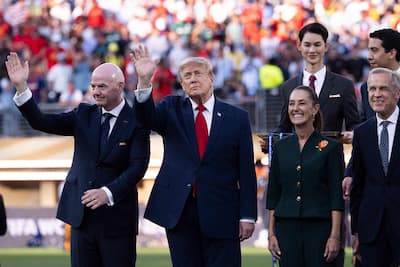
FIFA President Gianni Infantino, U.S. President Donald Trump and Mexican President Claudia Sheinbaum prepare for the awards ceremony during the 2026 FIFA World Cup final between Spain and Argentina at New York New Jersey Stadium on July 19, 2026 in East Rutherford, New Jersey.
Getty Images via AFP
According to Luc Laliberté, this trend is particularly linked to the policies of Donald Trump, which are causing many negative reactions abroad. Thus, even a global event like the World Cup would not have allowed the American tourism industry to reap the expected benefits.
“For hoteliers, among others, this is not the windfall we were hoping for, because when we see the FIFA circus, this gigantic machine, arrive, we say to ourselves “OK, at least there are people who will come”. There was some, but not up to the level of the American promises and investments at the base,” he adds.
FIFA, to advance Trump’s agenda
Beyond its sporting aspect, the 2026 World Cup would also have been marked by the political influence of the American president, believes Luc Laliberté.
According to him, the management of visas by Washington and the intervention of Donald Trump to remove a red card from an American player contributed to politicizing the event and serving his political agenda.
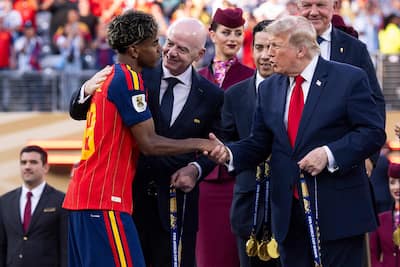
Lamine Yamal (#19) of Spain is congratulated by FIFA President Gianni Infantino and U.S. President Donald Trump during the awards ceremony following the 2026 FIFA World Cup final between Spain and Argentina at New York New Jersey Stadium on July 19, 2026 in East Rutherford, New Jersey.
Getty Images via AFP
“Visa issues, it was certain countries more than others that we targeted. Almost everyone has noticed this Somali referee, the best on the African continent last year, who cannot enter the United States without someone explaining it to us,” he lists.
The revocation of the red card awarded to the American player also provoked numerous reactions among teams and fans around the world.
“So, we had this political spectacle,” notes the analyst.
To watch the full interview, click on the video above.