
Oil prices slowed their rise on Tuesday after Donald Trump abandoned a proposed 20% tax on ships transiting the Strait of Hormuz, in favor of trade agreements, while the threat of an imminent reestablishment of the American naval blockade targeting Iranian ports persists.
• Also read: Donald Trump abandons his plan for a 20% tax on ships passing through the Strait of Hormuz
• Also read: Inflation calmed a little in the United States before the resumption of hostilities in the Middle East
Like Tehran, which plans to charge for passage through the Strait of Hormuz, Donald Trump said on Monday that he wanted to levy a fee equivalent to 20% of the value of cargo in exchange for the protection of this maritime route, in defiance of international law and the principle of freedom of navigation.
For the Bimco shipowners association, “the additional cost” which would have resulted from such a tax would have constituted “an additional barrier to transit” via Hormuz.
But in a message published Tuesday on his Truth Social network, the American president declared that he had “decided” to replace this project with “trade and investment agreements that the different Gulf States will make in the United States”.
After having climbed more than 5% earlier in the session in the midst of a military escalation between Tehran and Washington, the price of a barrel of Brent from the North Sea, for delivery in September, rose 1.72% to $84.73 around 11:35 a.m.
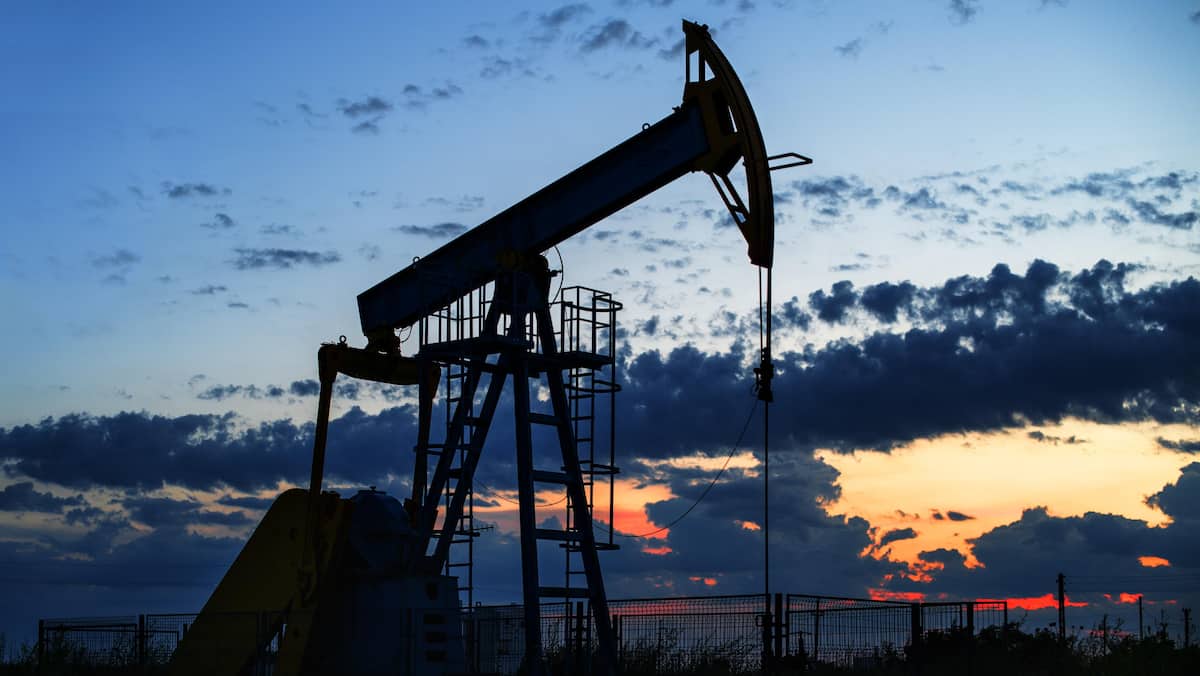
Oil pump, oil derrick, energy industrial machine for oil
Photo Fotolia
That of its American equivalent, West Texas Intermediate (WTI), for delivery in August, increased by 1.59% to $79.38.
The two crude benchmarks had gained up to more than 10% on Monday, also supported by the announcement of the establishment of a new blockade of Iranian ports, which is due to come into force on Tuesday at 3 p.m., according to the American army.
“The loss of Iranian crude oil, which has represented on average 2% of global demand since the signing of the memorandum of understanding” between Washington and Tehran on June 17 – which resulted in the lifting of the previous blockade – “will be felt on world markets,” notes Vivek Dhar, of CBA.
The analyst estimates that around 40 to 50% of the oil that has left the Strait of Hormuz since June 18 is attributable to Iran, compared to a share of 10 to 15% before the war.
“The real unknown is the reaction of the non-Iranian supply” according to him, because the Islamic Republic “now has a strong incentive to reestablish its own blockade”.
John Evans, analyst at PVM Energy, notes that “this deterioration of diplomacy and this acceleration of exchanges of fire took the market somewhat by surprise”.
But Donald Trump still estimated, in front of the press at the White House, that an agreement with Iran was still “possible”, consultations with the mediators continuing according to Iranian diplomacy.