
When they dig into the ground of Philadelphia on July 4, 2276, the Americans of the future will unearth an imposing metal cylinder weighing more than 400 kilos, filled for their attention with hundreds of objects and documents from all over the country, buried for the 250th anniversary of the United States.
• Also read: Former Olympic athlete accused of damaging Lincoln Memorial basin
• Also read: VIDEO | Fall in a ravine: a seriously injured Quebec hiker rescued by helicopter at Mount Washington
Firmly sealed at the beginning of June, the heavy stainless steel capsule will be buried on Saturday, the 250th anniversary of the United States Declaration of Independence, near the place where it was signed in 1776. Reopening date: July 4, 2276.
This is not the only gift from the past reserved by the America of today for that of the future. Another capsule intended to only be reopened for the country’s 500th anniversary was unveiled in Washington, right in the Capitol, a few days ago.
If its contents have not been detailed, the Philadelphia capsule, buried in front of “Independence Hall”, has revealed all its secrets.
The 50 states and five American territories (Puerto Rico, Guam, Northern Marianas, Samoa and American Virgin Islands), the capital Washington, and sports and cultural institutions, helped to constitute “a representative collection of the United States at 250 years old,” summarizes Rosie Rios, head of the America250 organization responsible for celebrating this anniversary, to AFP.
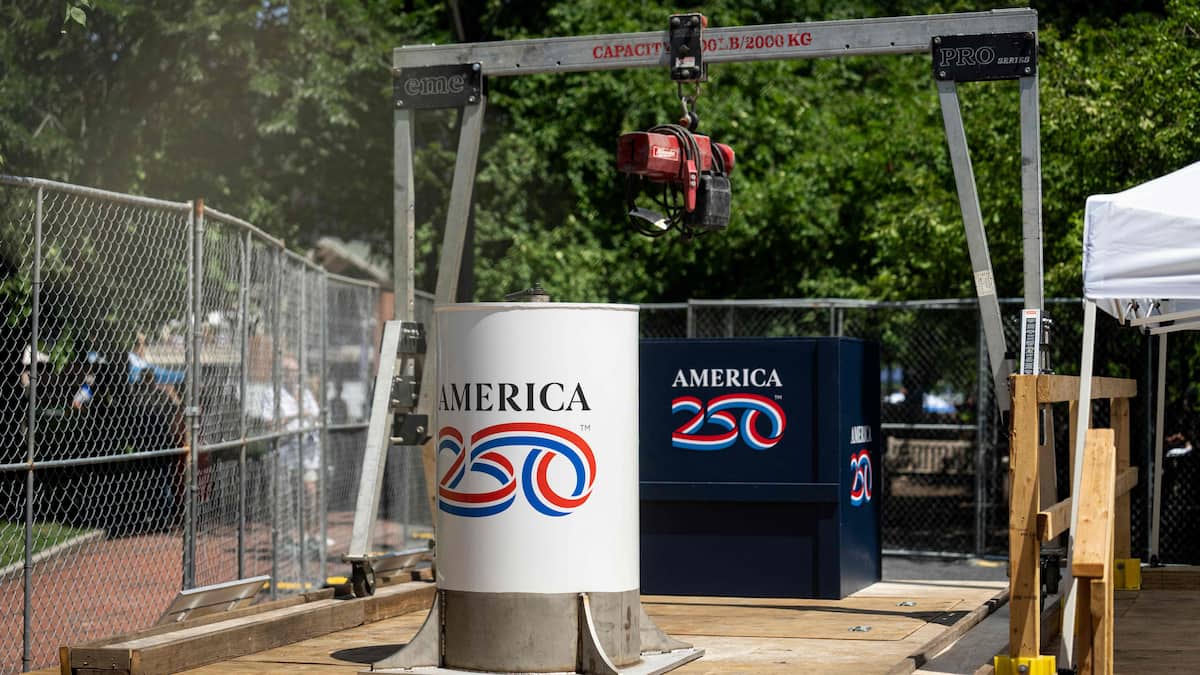
The America 250 time capsule, which will be buried on July 4, 2026 and reopened in 2276, at Independence National Historical Park on July 2, 2026 in Philadelphia, Pennsylvania.
Getty Images via AFP
Eagle feather and AI
Slipped in, from Wisconsin, was a beige-brown feather from “Old Abe”, an eagle who participated in around thirty battles during the Civil War, and from Ohio, a piece of fabric from the flying machine of the Wright brothers, pioneers of aviation, dating back to 1903.
Maine chose a whale bone from an endangered species, the North Atlantic right whale.
Others preferred ultra-modern accounts, like California, with artificial intelligence agent Claude’s response to the prompt: “Write me a prediction of what California will look like in 250 years.” America250 selected a latest generation orange iPhone.
Jumbled together, in addition to a quantity of letters and coins, were selected a bookmark woven by the Wabanaki, a Native American tribe on the East Coast, a diamond from Arkansas, a recipe for “biscochito”, an anise and cinnamon cookie, a specialty of New Mexico, and even a souvenir pin of the NBA title of the Oklahoma City Thunder in 2025.
Certain objects were excluded for conservation reasons. A leather American football, for example.
This is the puzzle of such an adventure: how to give it the best chance of resisting for centuries to come?
Protective bell
In the process, Jay Nanninga, a mechanical engineer at the National Institute of Technology (NIST), racked his brains when it was no longer a question of placing the capsule in a statue, but of burying it. He considered different shapes, “a square, a cylinder and a star”, he tells AFP. The second, limiting “welds and joints”, won out, and stainless steel stood out for its resistance to corrosion.
The main difficulty? “Keep the contents of the capsule dry,” he identifies. To do this, a protective metal bell will surround it and create an air hole preventing water from rising there, explains the engineer. Finally, a wire of indium, a malleable metal capable of filling in microscopic imperfections, seals it hermetically. Like the compartment reserved for the cell phone, made of components “destructive, ready to break and leak everywhere”.
Paper documents are stored in another separate, sealed compartment, for a “double layer of protection”. Other items are stored in cardboard boxes.
“I think stainless steel will be in good condition in 250 years,” fingers crossed Jay Nanninga, even if science only has a hundred years of hindsight on the material.
America is not on its first try. A capsule designed in 1876 for the centennial of the United States was reopened in 1976. Another, designed for the bicentennial, is kept in the National Archives and should be in fifty years, in 2076, recalls Rosie Rios.
With this new capsule, she anticipates, “we want future generations to have an authentic glimpse of who we were at 250 years old. What were our values, what we built, and how we perceived ourselves as a nation. »