
The Iranian delegation left the venue on Sunday where talks with the United States are being held in Switzerland, after a message deemed “insulting” from Donald Trump according to state media, witness to the tensions surrounding these negotiations already weakened by hostilities in Lebanon.
• Also read: Agreement with Iran: “It’s the equivalent of building your house on sand”
• Also read: Iran warns talks with US cannot move forward without peace in Lebanon
• Also read: Negotiations between Iran and the United States started in Switzerland
The discussions must lead, within 60 renewable days, to a final agreement to put an end to the conflict in the Middle East, triggered by Israeli-American strikes on Iran on February 28 and which caused thousands of deaths, mainly in Iran and Lebanon.
According to the government agency Irna, the Iranian delegation “left the building where the negotiations were taking place”, which had entered “a difficult phase after 80 minutes of discussions and an interruption, following the publication of an insulting message from the President of the United States”.
However, according to a diplomat close to the negotiations, the Iranians remain “committed” to the negotiations, conducted under the mediation of Pakistan and Qatar.
The delegation “did not communicate to the mediators its intention to leave,” said this diplomat on condition of anonymity.
On his Truth Social platform, the American president urged Tehran to prevent its allies in Lebanon, in reference to Hezbollah, from “causing problems”, otherwise the United States would resume its strikes.
“They had better weigh their words; our armed forces are ready to respond differently,” replied the influential head of the Iranian negotiating team, Mohammad Bagher Ghalibaf, on X.
Under the terms of the US-Iranian memorandum of understanding signed last Wednesday, the two sides must “refrain from threatening the use of force against each other”.
“New page”
The mutual warnings were issued shortly after the talks opened at the Bürgenstock hotel, overlooking Lake Lucerne in central Switzerland.
They should last “a few days”, according to American Vice-President JD Vance present on site, but who can only stay “a day or two” in Switzerland, where the emissary Steve Witkoff and Donald Trump’s son-in-law, Jared Kushner, are also located.
JD Vance called these negotiations “historic” and hoped that they would “turn a new page to transform our relationship with the Iranian people.”
But there are many disagreements, particularly over the Iranian nuclear program, which has poisoned bilateral relations for decades.
According to Iranian state television, it was not discussed during the first discussion session. This same source claimed that the Iranian delegation had refused to pose for a photograph with the American representatives.
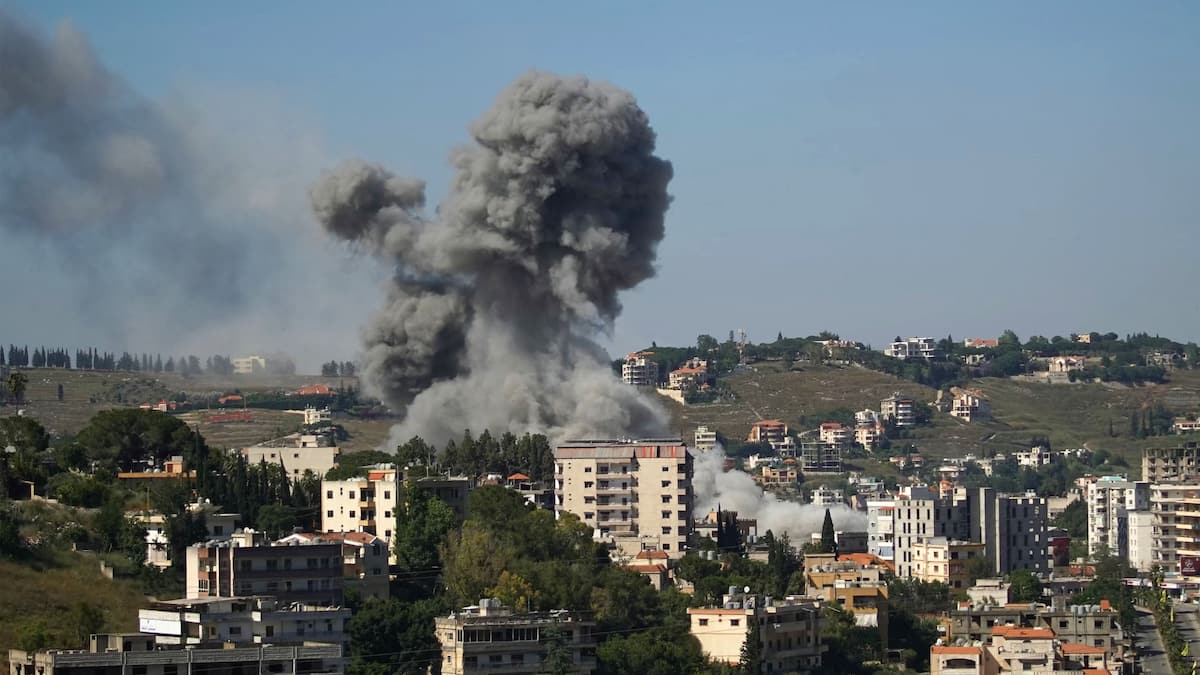
The discussions also open in the shadow of the clashes between Israel and the pro-Iranian Hezbollah which continued Friday and Saturday in Lebanon, despite a clause in the framework agreement providing for the end of hostilities on all fronts, and after the new closure, in retaliation, of the Strait of Hormuz announced on Saturday by Tehran.
Strikes by the Israeli army, which occupies part of southern Lebanon, left at least 30 dead on Saturday.
No agreement with the United States is possible without a cessation of hostilities in Lebanon, warned the spokesperson for the Iranian Foreign Ministry, Esmaïl Baghaï.
“As long as necessary”
The Israeli army will remain in southern Lebanon “as long as necessary”, assured Prime Minister Benjamin Netanyahu. For his part, the leader of Hezbollah, Naïm Qassem, refused any Israeli security zone in the south of his country.
More optimistic, Mr. Vance assured Sunday that he had noted that “considerable progress” had been made in recent days “to ensure that the ceasefire holds in Lebanon.”
Since Saturday, “a fragile truce has been in force,” noted Mr. Baghaï, while Israeli operations in Lebanon have left 4,106 dead since the beginning of March, according to Beirut, and the Israeli army has recorded 36 soldiers killed there.
In a possible sign of relaxation, Israel announced the lifting, from Monday morning, of all gathering restrictions linked to the war in the north of the country, near the border with Lebanon.