
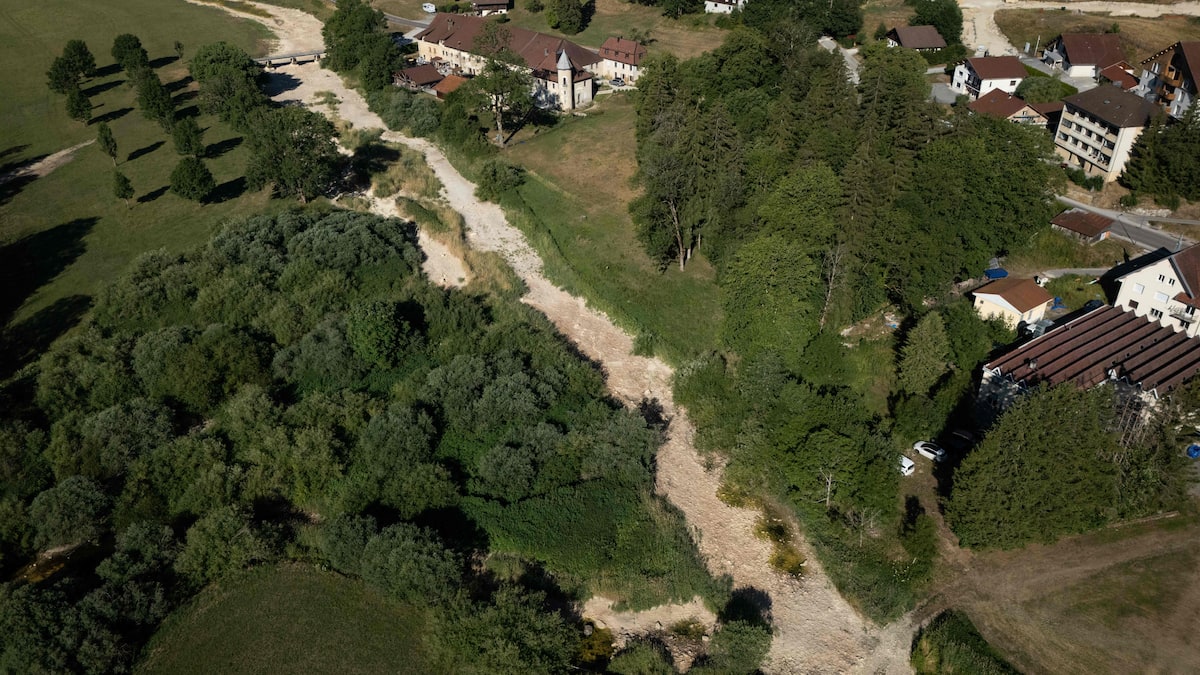

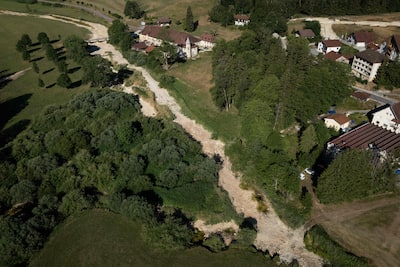
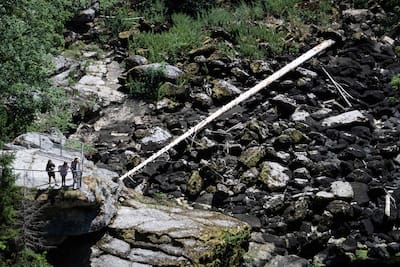
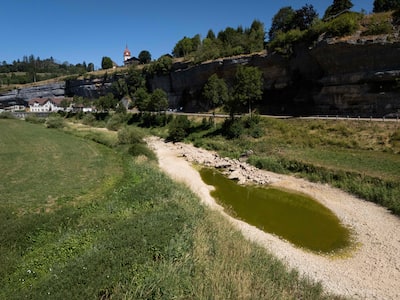
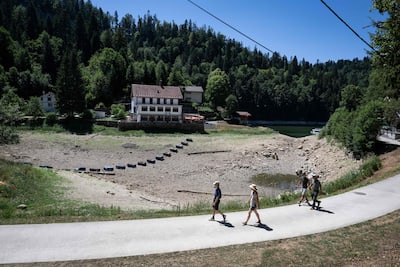
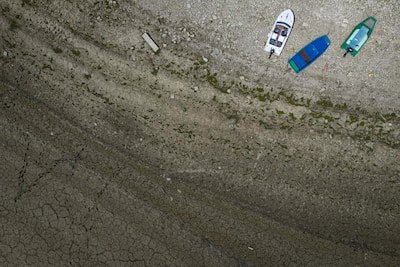
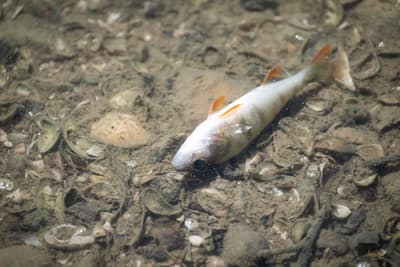
For several kilometers, only rocks and pebbles remain: near the Franco-Swiss border, the Doubs river has disappeared, the most striking manifestation of the drought which is currently affecting the French department of the same name, placed on “heightened alert”.
• Also read: PICTURES | Trapped in their vehicle or overtaken by flames: at least 12 dead in a forest fire in southern Spain
• Also read: With the heatwave, Western Europe experienced the hottest month of June in its history
• Also read: Absolute heat record recorded in Barcelona, at 40.7°C
“The Doubs flows as far as Arçon”, a village of 1000 inhabitants located at an altitude of 800 metres, “but then it’s desert”, alarms Fabien Henriet, the mayor. The river “reappears much further away, next to the small town of Morteau, thanks to underground sources,” continues the elected official. “It’s lunar, and it’s sad. I would like to no longer see this landscape.”

AFP
On the Haut-Doubs plateau, on the borders of the Jura mountains, the karst nature of the soils, with its numerous faults and cavities, easily allows water to infiltrate underground and disappear on the surface. Residents are therefore accustomed to periods of low water, but such low water, which leaves the river bed dry, is worrying.
AFP
“Before it could happen in August,” but “now it’s earlier, longer, and stronger,” observes Mr. Henriet.
AFP
“Limit limit”
Beyond the impact on landscapes and biodiversity, drought has numerous consequences, starting with disruptions to the water supply of residents and businesses. In Maisons-Du-Bois-Lièvremont, Olivier Masson has been carefully monitoring the level of the reservoirs for several weeks, to avoid cuts.
AFP
“It was nothing. At almost three hours, the cheese factory would not have been able to work if we had not noticed a drop in levels, confides this road worker who constantly keeps an eye on the alarms on his phone, and comes very regularly to read the meters, including at night and on weekends.
“You have to play with the floodgates so that everyone is fed, it’s a job,” he smiles. “And when we are really exhausted, when we can’t do it anymore, we buy water” from a town located about ten kilometers away. “We did it last week but we don’t really like it, and neither do they because they’re borderline limited.”
AFP
“It adds up quickly”
Elsewhere in this region, two municipalities have been supplied with water by 30 cubic meter tank trucks for two weeks, a service which has a cost (300 euros per truck).
“It’s an emergency situation,” describes Anthony Mérique, vice-president of the community of municipalities, responsible for water. “It adds up quickly. And if this continues, there will be other municipalities affected,” he worries.
Municipalities also fear a drop in their income linked to forest exploitation: drought favors the development of bark beetles, an insect which wreaks havoc on pine and spruce.
AFP
“It’s been a few years since we had less damage, but with a year like this, we’re afraid it will start again,” worries Anthony Mérique. “And we won’t be able to see it until next spring.”
Drop in milk production
Farmers, too, are affected by the precipitation deficit, -55% compared to the regional normal in June, and which continues in July, according to Météo-France. Dried up, the meadows have turned yellow, breeders have to bring the animals in to feed them.
“We have started the winter fodder stocks, all the farms in the sector are in the same situation,” assures Patrice Glasson, dairy producer.
AFP
“It’s been a week since we realized that we were going to run out of stocks,” continues the breeder, who is worried about the health of his 40 cows and 50 heifers in the face of waves of heatwave. “They are weakened, they lack energy. A month ago, I was making 25 liters of milk per day per cow, today I am at 19 or even 18.”
“It’s no longer the Haut-Doubs we know,” he concludes, a little dejected. The heatwave of 2003 had already brought about a shift, “but this year it’s stronger”.


