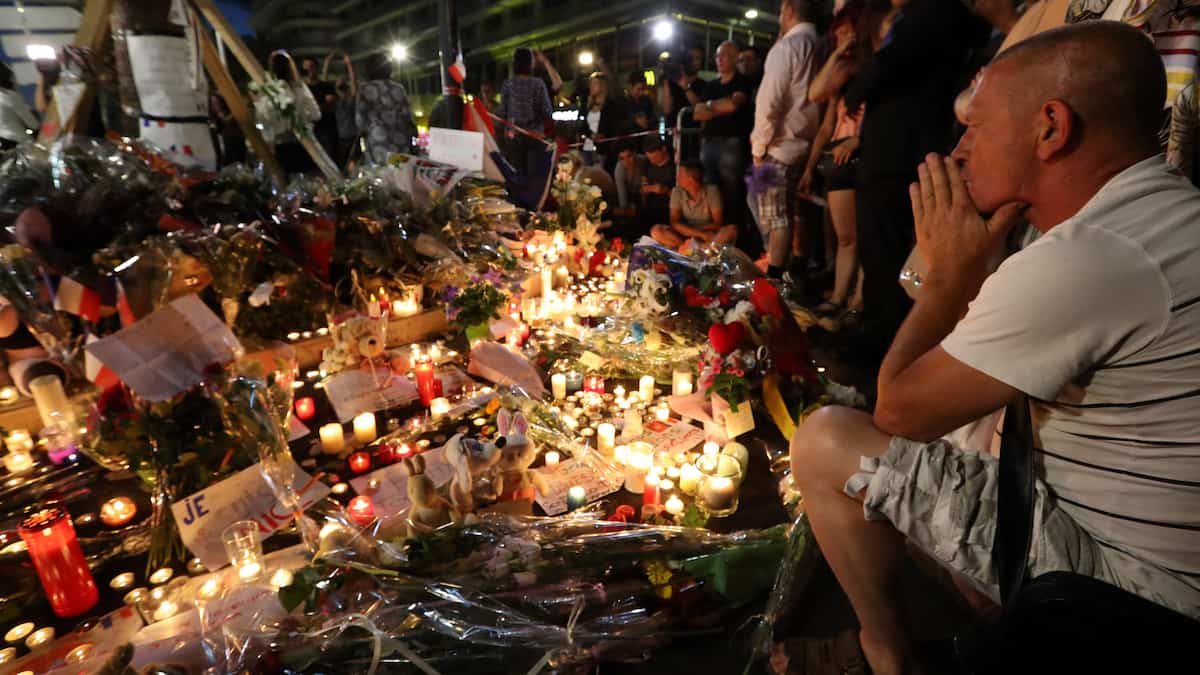

On this national holiday evening in France, there were around 3,000 at the fireworks display, 15 were killed, the attack of July 14, 2016 on the Promenade des Anglais in Nice struck an unprecedented number of children in Europe.
• Also read: PICTURES | Trapped in their vehicle or overtaken by flames: at least 12 dead in a forest fire in southern Spain
• Also read: 41-year-old woman killed by her ex while calling police in France
There is this 18-month-old baby whose mother threw her before being hit by the killer truck, this 4-year-old girl pinned to the ground to pass between the wheels, this 10-year-old boy responsible for covering his little brother’s eyes to prevent him from seeing the carnage, this 12-year-old child burned all over her body, this 13-year-old teenager who lost her twin sister…
Ten years after the attack which left 86 dead and hundreds injured, minors represent 25% of the nearly 3,000 victims compensated by the Guarantee Fund for Victims of Acts of Terrorism.
In total, psychologists at the Lenval children’s hospital, located on the famous “Prom” almost where the truck began its deadly journey, followed more than 700 child victims, explains Arnaud Fernandez, head of the Expert Center for Pediatric Psychotrauma (CE2P).
This pioneering structure in France, created six months after the attack, benefited from the Norwegian experience after the massacre in July 2011 on the island of Utøya, where 69 labor activists were killed, many of them teenagers.
The CE2P team also collaborates with psychologists working with young victims of the attacks during a concert in Manchester in May 2017 (22 deaths including seven children) and on the Ramblas in Barcelona three months later (16 deaths).
“But Nice is really a special attack. Whole families. Children. A murder weapon which is an everyday object that we come across all the time. This is what revives. Which reactivates. And that’s why it doesn’t happen,” explains Hager Ben Aouissi, president of the “Une chemin des enfants” association, which supports another 150 children.
Struck in the context of a family outing, many of the young victims have lost loved ones and must grow up with brothers and sisters, parents, grandparents and cousins who are themselves traumatized.
A CE2P publication cites the example of a 4-year-old child who remained for hours in the arms of his father in shock, looking for a deceased friend. In his games, the child kept putting figurines on the ground and it took him months of monitoring to bring in a fire truck.
– “They remember everything” –
According to the preliminary results of a large study launched by the CE2P with hundreds of children requiring follow-up, 80% of them presented anxiety disorders and 62% post-traumatic stress syndrome.
And the proportion remains the same for the youngest. “We can’t say: ‘he’s only 2 years old, he’ll forget,’” notes Dr. Fernandez.
“They remember all the details, all the smells,” confirms Ms. Ben Aouissi. “And when they think about their childhood, that’s all they think about.”
Anxiety attacks, panic attacks, nightmares, stress-related illnesses, eating disorders, sleep disorders, mood disorders, attention disorders, depression… The consequences are legion.
Schooling often became a challenge, especially as classmates were not always understanding, especially for those who were in Nice on vacation and felt isolated back home.
Faced with needs, CE2P has put in place a whole range of care, accelerating the adaptation for the youngest of behavioral and cognitive therapies and EMDR (which uses eye movements), explains Morgane Gindt, psychologist. If many patients are now doing better, “with ups and downs”, the CEP2 is still following 86 children, which remains “colossal”.
Healing also involves creating new memories. Thus, the association “A Way of Children” organized in June an outing to a fire station which intervened on the evening of the tragedy, but also to the national football center of Clairefontaine, near Paris, just before the departure of the French team for the World Cup.
“For the first time in almost ten years, I saw children crying with joy,” says Ms. Ben Aouissi.