
The United States will strike Iran tonight, President Donald Trump warned on Wednesday, while assuring that the new deadly clashes would end “very quickly” and leaving the door open to continuing diplomatic negotiations with Tehran.
• Also read: After resumption of hostilities, Trump declares ceasefire with Iran “finished”
• Also read: NATO chief tries to reassure allies shaken by Trump attacks
• Also read: Falling oil price ‘gives Trump room to maneuver’ to restart hostilities with Iran
The ceasefire no longer holds, said the American president, after exchanges of strikes which weakened efforts towards a lasting truce, with the two mediators – Qatari and Pakistani – calling, like the UN, for de-escalation.
As at the end of June, the strategic Strait of Hormuz is at the heart of tensions: Iran claims to impose passage rights there, despite American opposition, and threatens ships bypassing the only route it has authorized, along its coasts.
The same scenario repeated itself: shootings attributed to Tehran on three commercial ships, then strikes by the United States against more than 80 targets during the night from Tuesday to Wednesday in Iran, according to the American army.
Eight Iranian soldiers were killed in Bandar Abbas (south) and Bushehr (southwest), state television announced on Wednesday, citing a military statement. Media reported explosions near the strait and at Bushehr, off the island of Kharg, the country’s main oil terminal.
In retaliation, Tehran said it struck 85 installations on US military bases in Kuwait and Bahrain.
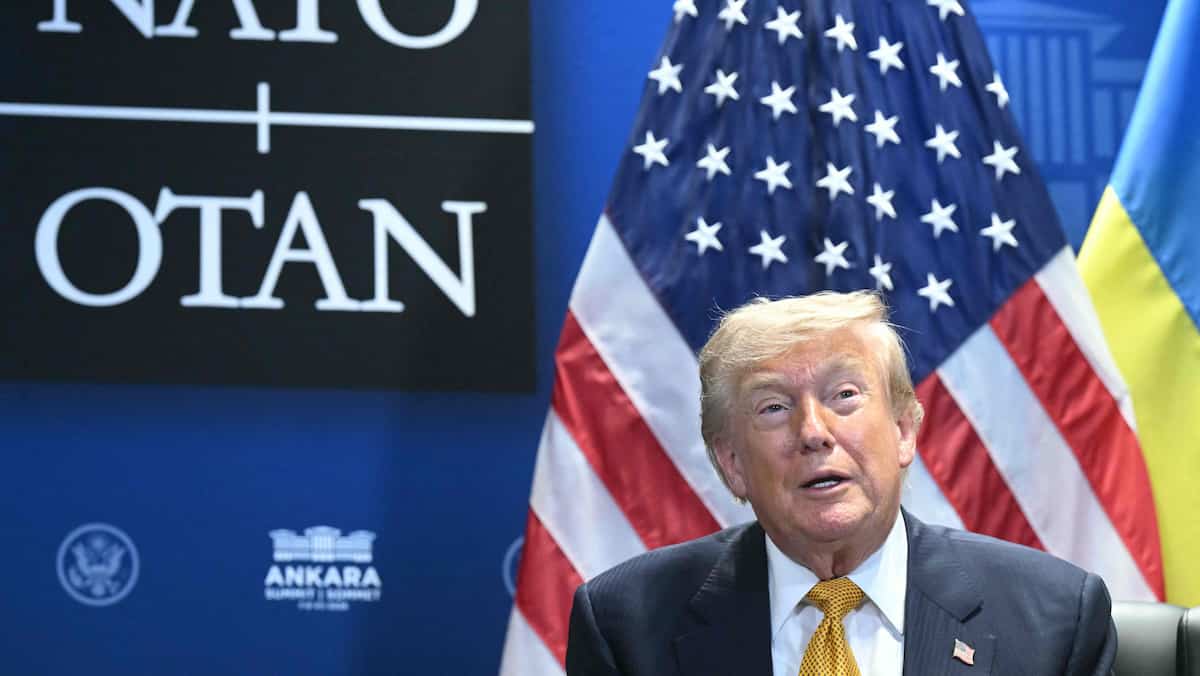
“They hit a few ships and therefore we hit them much harder”, but “we do not intend to continue in the long term”, declared Donald Trump, after a NATO summit in Ankara.

US President Donald Trump on July 6 during a press conference in the Oval Office.
Photo If
“I think what is happening will end very quickly,” added the American president, who had previously announced that the army was going to “hit hard” Iran “tonight”.
If he said he no longer wanted to “have any dealings” with Iranian leaders, considering that negotiating was “just a waste of time”, he indicated that his emissaries could continue their discussions.
The president’s comments, accustomed to about-faces, caused oil prices to jump by more than 8% on Wednesday, to $80.10 per barrel of Brent from the North Sea, an international benchmark.
“Very worried”
Qatar and Pakistan called to respect the memorandum of understanding, signed on June 17 thanks to their mediation, and to work towards de-escalation.
“Very worried”, UN Secretary General Antonio Guterres also called for the resumption of negotiations.
Mr. Trump’s rhetoric “does not necessarily mean that the memorandum of understanding has collapsed”, analyzes Ali Vaez, of the International Crisis Group (ICG) think tank, who does not see at this stage “a high risk of a return to all-out war”.
The two parties are trying to negotiate “through the use of force” the outstanding issues and the Iranians do not intend, according to the analyst, to give up control of Hormuz, which they consider “as their greatest achievement in this war”.
Washington on Tuesday reinstated its sanctions on Iranian crude, lifted by the memorandum of understanding which allowed the reopening of the strait, through which 20% of the world’s crude and liquefied gas (LNG) normally pass.
After finding this common ground, Washington and Tehran resumed their negotiations with a view to a lasting settlement of the conflict, triggered on February 28 by an Israeli-American offensive.
But the rhetoric remains martial: Iran warned the United States against a “violation” of the memorandum of understanding, warning that it would “take decisive measures to protect its interests and security”.
“Any support provided to the American army” for attacks against Iran “will be a legitimate target,” warned Tehran, which regularly accuses its Gulf neighbors of authorizing strikes from their territories.
” Distress “
The attacks in the Hormuz region “only exacerbate the fear (…) and distress” of the approximately 6,000 sailors still stranded in the Gulf, deplored the International Maritime Organization (IMO).
Kuwait condemned “repeated and unlawful attacks by Iran”. Without singling out Tehran, with which it is holding discussions on the management of Hormuz, Oman, located on the other side of the strait, also condemned the strikes.
Mark Rutte, the Secretary General of NATO, judged the American response “absolutely necessary”, a sign of “firmness”.
This renewed violence comes during the funeral of Supreme Leader Ali Khamenei, killed on the first day of the war and whose remains stopped in Iraq, before his burial scheduled for Thursday in his hometown of Mashhad, Iran.