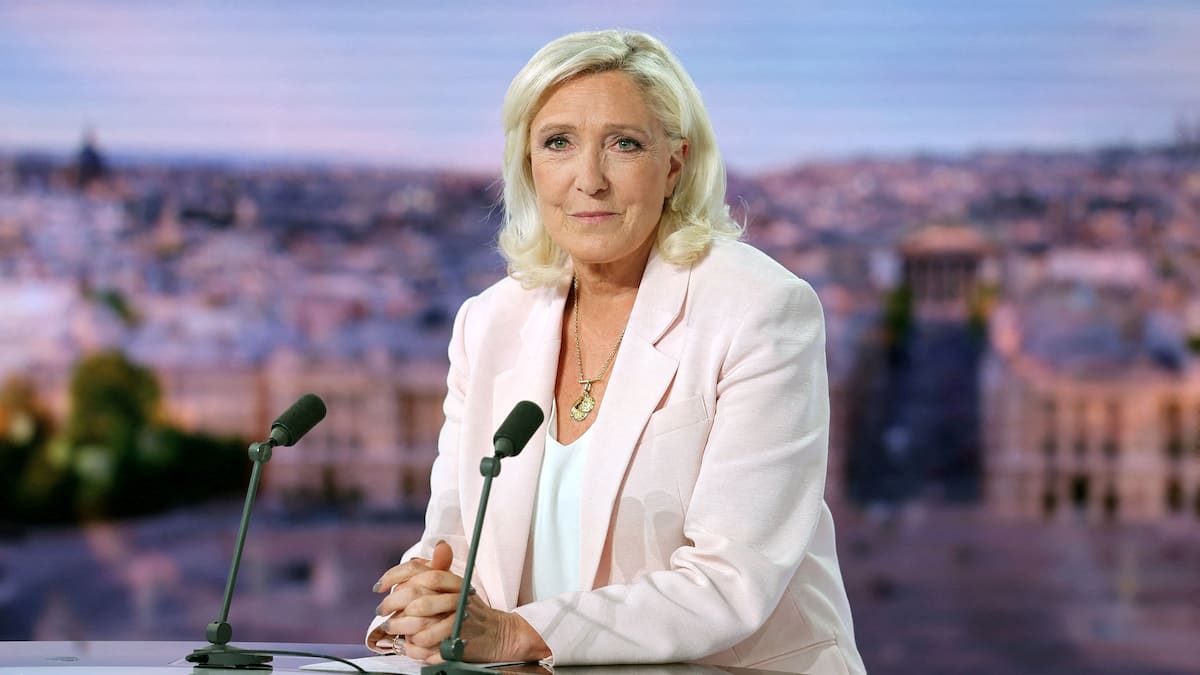

In the French presidential race, several personalities have already declared themselves and will face Marine Le Pen, the candidate of the far-right party.
• Also read: Sentenced to one year in prison under an electronic bracelet, Marine Le Pen will be a candidate in the presidential election
The leader of the National Rally (RN) formalized her candidacy on Tuesday evening, just a few hours after her conviction on appeal for embezzlement of European funds.
Between a match in the center, a divided right and a left accumulating candidates, who are the contenders to contest victory for the RN, given favorite in the polls?
In the center, match between two ex-prime ministers
Two former prime ministers of President Emmanuel Macron, Édouard Philippe (May 2017-July 2020) and Gabriel Attal (January-September 2024) have declared themselves candidates.
In the event of qualification for the second round, Mr. Philippe, 55, hopes to bring together the center and the right to win. He is, according to the polls, the best placed to contest victory in the National Rally.
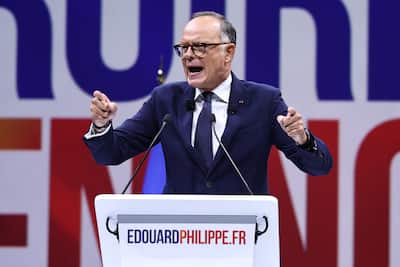
Édouard Philippe, candidate for the 2027 French presidential election, during his presidential campaign rally at the Adidas Arena in northern Paris on July 5, 2026.
AFP
The mayor of Le Havre (north-west) and president of the Horizons party, who announced his candidacy in September 2024, held his first major campaign rally in Paris on Sunday, where he promised to “restore order to the affairs of France” and make “the interests of our children”, particularly in education, the “compass” of his five-year term.
Facing him, Gabriel Attal, who was also Minister of Education, formalized his candidacy in May. Heir to the Macronist party En Marche!, often presented as the “clone” of Emmanuel Macron, he dreams of breaking the record for youngest elected president: he will be 38 years old at the time of the election.
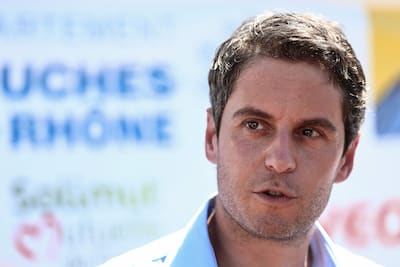
Candidate for the 2027 French presidential election Gabriel Attal speaks to the media during his visit to the World Pétanque Championships in Marseille, southeastern France, July 5, 2026.
AFP
The hypothesis of this dual centrist candidacy was recently described as “dangerous” by Édouard Philippe himself, because it would favor, in his eyes, a duel between the RN and the radical left party La France Insoumise (LFI) in the second round.
On the right, the return of the divisions
Within the traditional right, Bruno Retailleau, still Minister of the Interior a few months ago, was designated candidate in mid-April by members of the party he leads, Les Républicains (LR), during an internal consultation.

The president of the right-wing Les Républicains (LR) party and candidate for the 2027 French presidential election, Bruno Retailleau, attends a meeting at the headquarters of the Spanish Popular Party in Madrid, June 22, 2026.
AFP
But in his camp the dissensions, which undermined the party during Emmanuel Macron’s two mandates, have resurfaced. The leader of the LR deputies, Laurent Wauquiez, gave half-hearted support to Édouard Philippe on July 1, calling without naming Bruno Retailleau, who does not reach 10% in the polls, to “know how to withdraw if it is necessary”.
A former member of LR, David Lisnard, mayor of Cannes (south-east) also declared himself a candidate.
On the left, uncertainty and multiplication of applications
The leader of the radical left, Jean-Luc Mélenchon, 74, announced his fourth candidacy for the presidential election in early May.

The leader of La France Insoumise (LFI), Jean-Luc Mélenchon, poses before an interview on the evening news of the French channel TF1, where he announced his candidacy for the 2027 French presidential election, on May 3, 2026.
AFP
His movement La France insoumise (LFI) intends to take advantage of the disorder in the rest of the left, which is torn apart over the question of the organization, or not, of a primary to nominate a candidate from the “non-Mélenchonist” left.
Several left-wing personalities and groups (LFI, the social-democratic Place publique movement, the Communist Party) refuse to participate.
The Socialist Party is divided on the subject. If party boss Olivier Faure is in favor, his internal opposition is against it. Activists are expected to decide on this issue on July 9.
Uncertainty and divisions favor the multiplication of applications, with more than ten candidates declared at this stage and others, such as the former President of the Republic François Hollande, maintaining the vagueness.
According to the polls, the two candidates best placed on the left at the moment are: Jean-Luc Mélenchon and Raphaël Glucksmann (Place publique), who defends a social-democratic line and intends to attract a useful vote by winning in the polls. He gave himself until September to formalize his candidacy.
Other left-wing figures such as the ecologist Marine Tondelier announced that they would run independently for the presidential election if a primary, increasingly poorly off to a good start, were not to be held.