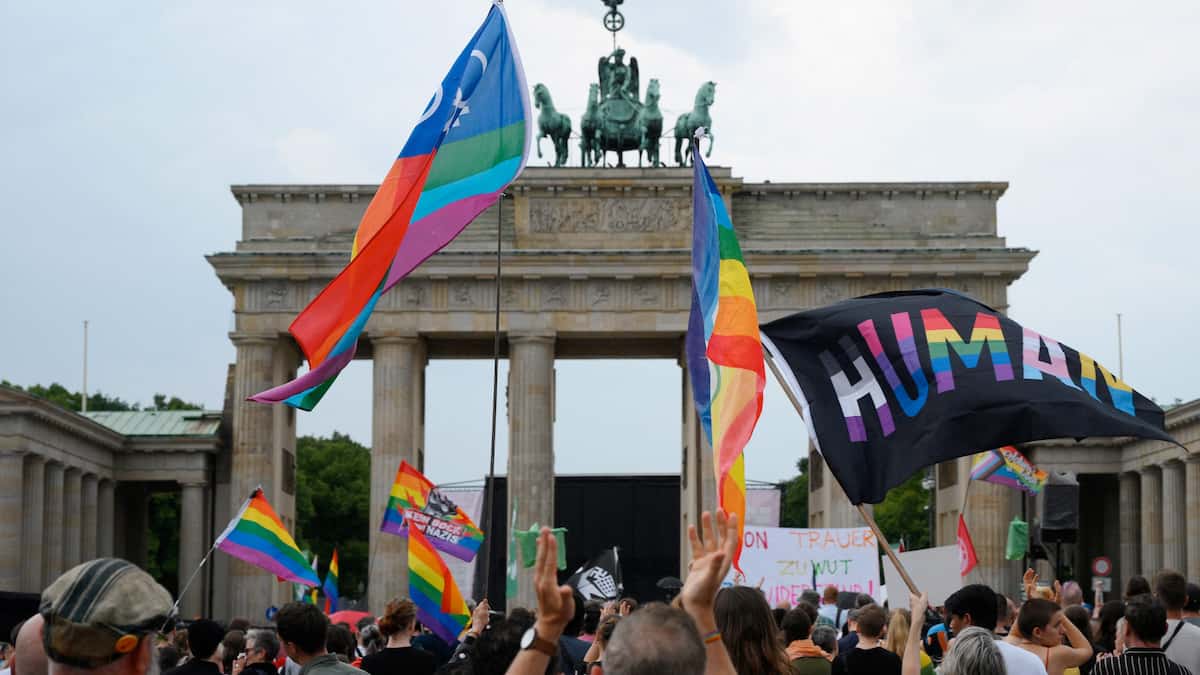

After the attack on the Berlin pride parade, the controversy grew on Monday in Germany over a possible laxity of justice, accused of having let the suspect, a radicalized Islamist with a long record, free.
• Also read: “I experienced a lot of sadness”: a Quebecer living in Berlin reflects on the attack at the Pride parade
• Also read: Berlin attack: Islamist suspect killed by police
• Also read: Pride parade in Germany: one dead and 16 injured, hit by a vehicle
Less than two months before a close election for mayor of Berlin, this attack which caused the death of a 65-year-old Polish woman and left 29 injured, could benefit the far right (AfD) which is booming throughout the country.
AFP
Killed on Sunday evening by the police, the day after the attack, the suspect, Abdul Ballout, a 21-year-old German citizen of Lebanese origin, was sentenced in May to a suspended prison sentence of one year and ten months, “for preparing a serious act of violence undermining the security of the State” after trying to join the Islamic State jihadist group in Syria via Lebanon.
Abdul Ballout then claimed to have distanced himself from IS and the court took into account his six months of pre-trial detention in Germany and his three months in prison in Lebanon, the country where he was convicted for his membership in the jihadist group.
Since the revelation of this course on Sunday, criticism of judicial failings has rained down from all sides.
“It is still too early to answer the question of what political consequences we draw from this brutal attack. But one thing is certain: we must not be satisfied with mere declarations,” admitted Chancellor Friedrich Merz on Monday.
“I still do not understand how this man, although placed under constant surveillance, was able to approach gay pride without being detected,” he added.
“The danger has been minimized,” laments Rolf Tophoven, expert at the Institute for Terrorism and Political Security Research in Essen, in an interview with AFP.
The alleged perpetrator of the attack was surrounded in an allotment garden late Sunday afternoon, where he was shot dead by police after running towards officers, “with a bladed weapon”, according to the police.
“Tackling the root”
On her website, the head of the AfD list in Berlin, Kristin Brinker, called for “an immediate end to the policy of appeasement pursued until now towards Islamists prone to violence”.
The candidate of the conservatives (CDU), party of the chancellor and the current mayor of Berlin, agreed that there was “a problem in this city linked to political Islam”.
“We must attack Islamism at the roots. It doesn’t just start at the moment of the violent act. It starts much earlier,” demanded Stefan Evers, in an interview with the daily Die Welt.
Berlin is one of the German cities with the largest Muslim populations.
“The police state did not act correctly in this case,” said Alfred Kubitz, a Bavarian retiree on vacation in Berlin, interviewed by AFP in front of the Brandenburg Gate, a few hundred meters from the scene of the attack, where flowers were laid to honor the victims.
Quoted by the German daily Handelsblattthe conservative MP Marc Henrichmann, president of the parliamentary committee for control of the intelligence services, stressed that “the individual freedoms of extremists and Islamists already known to the justice system must no longer be overvalued from the moment there is a danger for the lives of other people”.
The president of the Federation of German Criminal Police Officers, Dirk Peglow, states that “for a person with such dangerous potential, release from detention should not mark the end of state attention”.
In an interview with radio Deutschlandfunk, the integration delegate for the Berlin district of Neukölln, where many Muslims live, Güner Balci, for her part called for the most radical mosques to be closed “to send a clear signal”.