
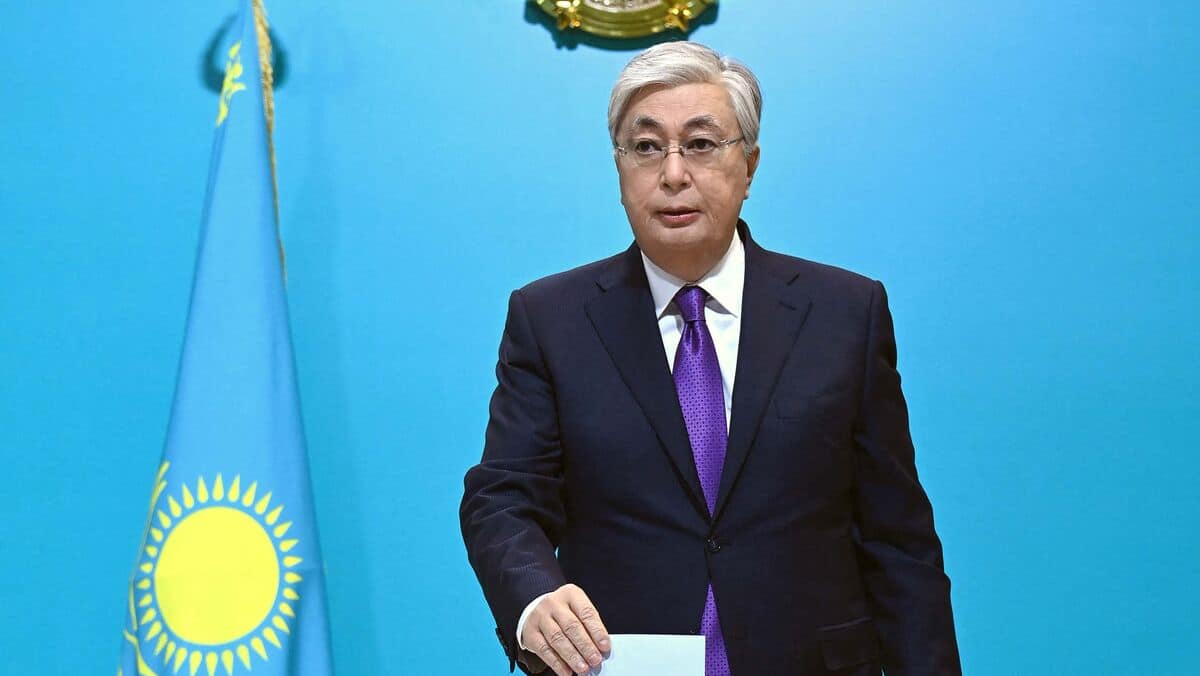

Kazakhstan’s leader Kassym-Jomart Tokayev told the Russian president on Saturday that the war in Ukraine must stop, a statement rarely made publicly to Vladimir Putin, as 20 people were killed in strikes in Ukraine and Russia according to authorities in both countries.
• Also read: Panamanians recruited for Russia-Ukraine war
• Also read: Eight dead in strike on occupied town in southern Ukraine
• Also read: Two dead in drone strike on Sumy, northern Ukraine
A few hours after long-range Ukrainian strikes in Russian territory, Kassym-Jomart Tokaïev considered that the conflict should be “frozen”, at the opening of a cooperation forum between Kazakhstan and Russia in the Siberian city of Omsk.
“It’s regrettable, young people are dying… All this must be stopped,” he said, sitting next to Vladimir Putin during a meeting broadcast on television.
Kassym-Jomart Tokayev, who is an ally of Moscow but has never expressed support for the Ukraine offensive, called the “roots” of the war “unintelligible to many, including us.”
The Kazakh president suggested returning to the 2022 Istanbul Accords and “then moving towards a long-awaited peace.”
The Russian president replied that he would inform him of the “details” of the war.
Negotiations aimed at ending the worst conflict in Europe since the Second World War are at an impasse: Washington’s attention is focused on the Middle East and Moscow maintains its demands, demanding that Kyiv cede territories.
“Tourist camp” affected according to the official installed by Moscow
These statements come as 20 people were killed on Saturday in Ukraine and Russia, according to authorities in Moscow and Kyiv.
The day before this new deadly toll, 21 people were killed during strikes in the two countries.
The UN recently warned that the number of civilians killed or injured in the conflict had jumped 37% in the first half of the year.
In the occupied part of the Zaporizhia region in southern Ukraine, the Moscow-installed official said a Ukrainian attack on a coastal village on the Azov Sea had killed twelve people, including four children.
Yevgeny Balitsky said a “tourist camp” was hit in the village of Kyrylivka, captured by the Russian army in the first days of its offensive, adding that 19 people were injured.
The spokesperson for Russian diplomacy “resolutely condemned these inhuman crimes”, referring to Kyrylivka and another strike which targeted a factory in Kirov on Friday.
Kyiv did not immediately react. Ukraine has increased its strikes on the Sea of Azov in recent months, targeting Russian ships.
Local Russian officials further reported the deaths of two people in the border region of Belgorod and another in the occupied part of the Kherson region.
Ukrainian President Volodymyr Zelensky, for his part, announced that a drone strike on a postal site in the city of Sumy (north-east) had killed three drivers.
Two more people have died in Russian strikes in southern Ukraine, according to local authorities.
Refinery in Siberia
Far from the front, the governor of the Siberian region of Tyumen, 1,700km east of the Russian capital, indicated that a refinery had caught fire, while the Russian athletics federation announced that a national competition in Yekaterinburg, in the neighboring region, had been interrupted due to a drone threat.
Ukrainian President Volodymyr Zelensky claimed responsibility for the attack targeting the refinery and added that a factory in Kirov, further west, which he said “supplies components for Russian weapons”, had been struck a second time, the day after an attack which killed five people there.
Already hit three times in one week, the Russian online sales giant Wildberries announced that it had evacuated its staff in Yekaterinburg, work being “suspended” but without the building having been damaged.
Ukraine is increasingly targeting remote Russian towns in retaliation for Moscow’s daily strikes as part of its offensive launched in February 2022.
The campaign, which Kyiv sees as a way to weaken the war effort and push Moscow to negotiate, has mainly targeted Russian oil infrastructure and triggered a fuel crisis in one of the world’s largest oil-producing countries.