
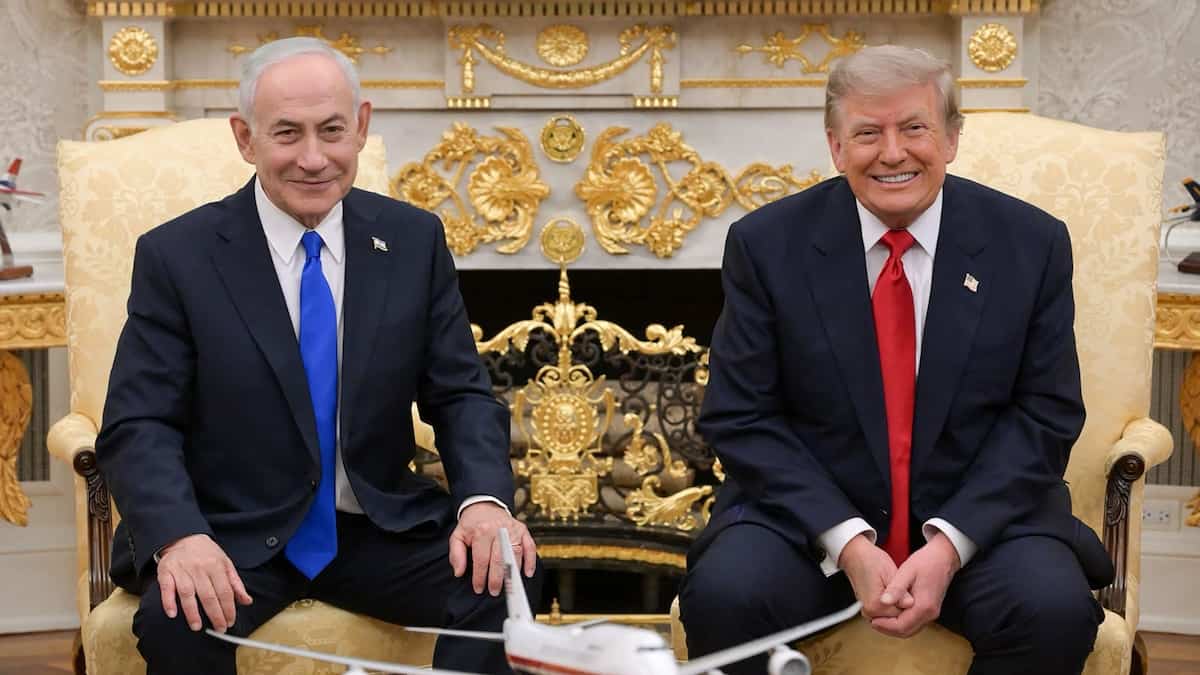

American President Donald Trump received Israeli Prime Minister Benjamin Netanyahu on Tuesday, a meeting described as “positive” by both parties, allowing them to reaffirm their refusal to see Iran acquire nuclear weapons.
In a video broadcast after the meeting by Mr. Netanyahu, the Israeli Prime Minister assured that he had had “the best conversation” with Donald Trump, explaining that the meeting had notably focused on their “common objective: to ensure that Iran does not acquire nuclear weapons”.
“It was an extremely positive meeting,” a source close to Mr. Netanyahu previously added.
For its part, the White House welcomed a “positive and constructive meeting” on X.
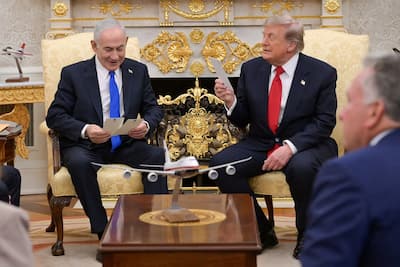
AFP
However, the closed-door interview, which lasted around an hour and a half and after which the participants had no exchange with the press, does not dispel the impression of differences between them.
It was their first meeting since the start of the war in the Middle East, and their eighth since Donald Trump’s return to power.
Washington says it wants to give diplomacy with Iran another chance, after two weeks of unprecedented bombing since the April ceasefire.
Israel, which jointly launched with the United States the offensive on Tehran on February 28 which triggered the regional war, did not take part in the last wave of clashes in July.
Upon his arrival in Washington on Monday, Mr. Netanyahu attended a dinner organized in memory of Senator Lindsey Graham, who died on July 11, his office said. He is also attending his funeral Tuesday afternoon, alongside President Trump and Ukrainian President Volodymyr Zelensky, who was also received at the White House.
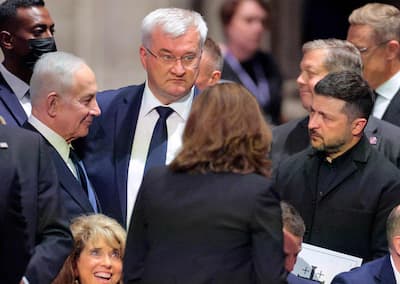
Getty Images via AFP
Mr. Netanyahu’s visit comes at a “critical time for the Middle East” as Iran continues “to favor terrorism over negotiations” and blockade the Strait of Hormuz, a strategic waterway, Danny Danon, Israel’s ambassador to the United Nations, said earlier Tuesday.
It also comes as the Prime Minister is seeking a new mandate, during the legislative elections on October 27, and the latest polls show him in difficulty.
“No breakup”
The relationships between MM. Trump and Netanyahu deteriorated sharply in April, during negotiations on a first ceasefire between Washington and Tehran, with Donald Trump sharply attacking his Israeli ally accused of obstructing diplomatic efforts.
The American president notably described Mr. Netanyahu as a “very difficult guy”. The Prime Minister had conceded “tactical disagreements”, while ensuring that he shared the same objectives in the war with his American counterpart.
Asked Tuesday morning about reports that Iran is fortifying Kolang Mountain (“Kolang” means pickaxe in Persian), Mr. Trump replied: “I don’t need Bibi (Netanyahu’s nickname) to tell me that. Bibi tells me this because he wants me to stay involved. »
“I know exactly what is happening in Kolang, it’s not a big problem. If we don’t reach an agreement, we will destroy it very easily,” he said on Fox News before the meeting.
On Tuesday, they were also to discuss the implementation of the framework agreement concluded under the aegis of the United States between Israel and Lebanon with a view to their exit from the state of war, the application of which remains difficult on the ground.
The discussions were also to focus on the Gaza Strip, against a backdrop of impasse in diplomatic efforts to begin the reconstruction of the Palestinian territory, devastated by two years of war between Hamas and Israel, and where the humanitarian situation is catastrophic despite a fragile ceasefire that entered into force in October 2025.
“The main issue is to show the whole world, Iran, but also Lebanon and other countries in particular, that there is no break or major disagreement between the United States and Israel,” Yonatan Freeman, an expert in international relations at the Hebrew University of Jerusalem, told AFP.
Any differences, according to him, relate more to the means (calendar, intensity of military operations or immediate objectives) than to the ends.
Several Israeli media outlets, citing political sources, reported that the security cabinet had approved the legal framework allowing the deployment of an international stabilization force (ISF) in Gaza, a decision presented as a gesture towards Washington.
This international force, which is part of the “Peace Council” promoted by Donald Trump, constitutes one of the components of the American system envisaged for the post-war period in Gaza.

