
Donald Trump judged on Monday that discussions with Tehran had “a good chance” of achieving results, while Iranian leaders denied negotiating with the United States, on the third day of pause in hostilities between the two camps.
• Also read: Iran denies the existence of negotiations with the United States
• Also read: Iran: Revolutionary Guards stop six ships in the Strait of Hormuz
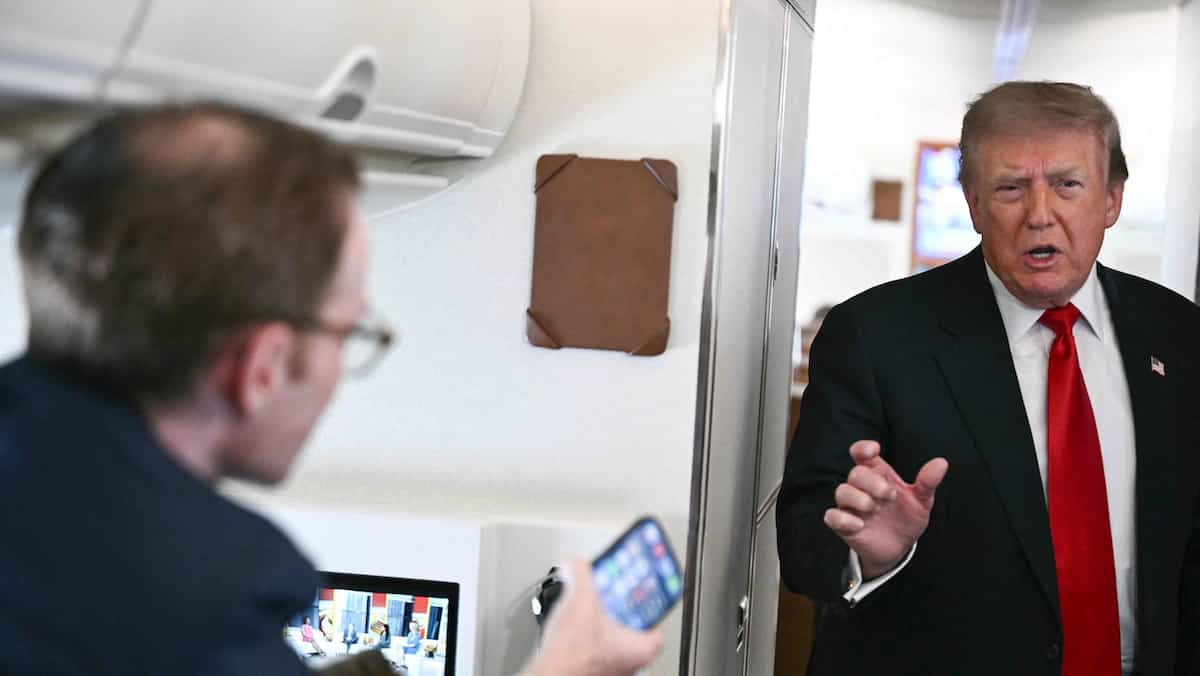
“We’ll see what happens. I think there is a good chance that something will happen,” declared the American president aboard his Air Force One plane, without further details.
“Mediators can send us messages from the Americans (…) But at the moment, we are not engaged in any negotiations with the United States,” had previously declared the spokesperson for the Iranian Ministry of Foreign Affairs, Esmaïl Baghaï.
Mr. Trump said that if the discussions did not succeed, “we would go back to what we were doing”, namely bombing Iran. He also brushed aside any concerns about a shortage of ammunition for the American army after several months of bombing on Iran, raised in recent days by the New York Times.
After 15 days of uninterrupted exchanges of strikes, despite the American-Iranian memorandum of understanding concluded in mid-June with a view to ending the war, hostilities ceased on Saturday.
But if the weapons remained silent in the main theater of the conflict, launched on February 28 by an American-Israeli attack against Iran, Saudi Arabia, Washington’s ally, claimed Monday to have intercepted a drone attack launched from Iraq by pro-Iranian groups.
Riyadh blamed these attacks on “terrorist militias supported by Iran”, without any claim being made.
For their part, Yemen’s pro-Iranian Houthi rebels announced on Monday that they had targeted Saudi oil infrastructure, which the kingdom did not confirm.
“Sensitive targets” in Saudi Arabia
After Saudi Arabia called on Baghdad to “take all necessary measures to prevent its territory from being used as a starting point for aggression,” the Iraqi government announced an investigation into the shootings.
The Wahhabi kingdom and other Gulf countries had blamed attacks on pro-Iranian armed groups in the previous phase of the conflict, but these factions in Iraq have not claimed any strikes since the resumption of clashes.
In Yemen, the Houthis claimed to have “struck” by drones “several sensitive targets and sites involved in the routing and transport of Saudi crude oil” towards Yanbu, the port city where a pipeline from the country leads to the Red Sea.
Riyadh, which supports the Yemeni government, and the Houthis resumed hostilities on July 13, after four years of truce, and the Yemeni rebels announced on July 20 that they wanted to block traffic in the Red Sea and the Gulf of Aden of ships from Saudi Arabia, the world’s leading exporter of crude.
Relaxation on the markets
In Tehran, Mr. Baghaï also affirmed that Washington was not involved in recent discussions with Oman on the administration of the Strait of Hormuz, once again blocked by Iran, and through which some 20% of the world’s oil and liquefied natural gas transited before the war.
Iranian-American hostilities resumed on July 7 against a backdrop of tensions in this strategic route: Washington said it had struck multiple military targets, while Tehran launched drones and missiles in retaliation against Washington’s allies in the region.
Iran insists on maintaining control of the strait and wants to charge for passage. According to state television, the Revolutionary Guard navy on Monday blocked six ships from using the strait, where they were attempting to pass through unauthorized routes.
Despite this persistent blockage, the barrel of Brent – an international benchmark – fell again on Monday, around $90, falling by more than 11%, sparking optimism in global stock markets.
Israeli Prime Minister Benjamin Netanyahu, expected at the White House on Tuesday for a first meeting since the start of the war, said on Sunday that he “fully supports the efforts” of Donald Trump to succeed in putting an end to Tehran’s nuclear ambitions.
“If he can get there without going back to high-intensity fighting, that’s great,” he said.