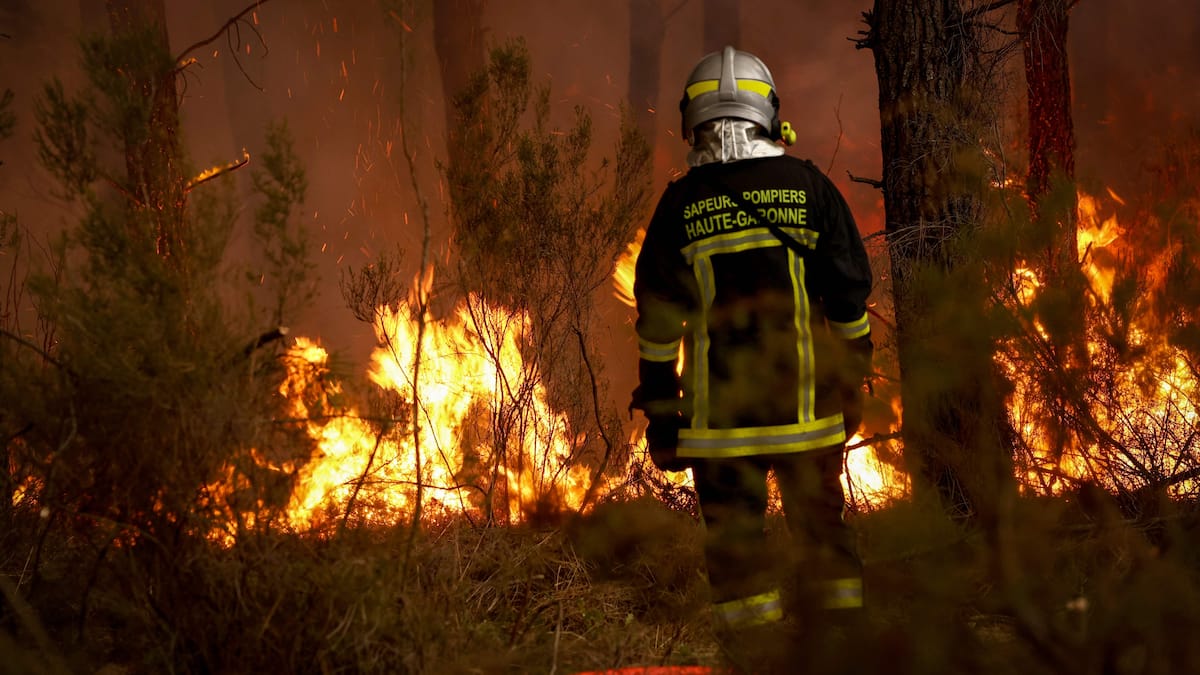

“It could leave at any time”: despite first signs of stabilization, the fires raging in France and Spain are still mobilizing hundreds of firefighters, an ecological and economic disaster for the Bordeaux region.
• Also read: Fire in Gironde: fire situation “generally stable during the night”
• Also read: Fires in France: a rare “fire storm” fuels the flames
• Also read: More than 325,000 refugees from the fire in France and Spain, the flames 15 km from the Bordeaux metropolis
These fires have already forced more than 325,000 people to flee, particularly near Bordeaux, in the south-west of France, where the flames are 15 km from the city, but also in several Spanish regions where one death has been reported in the Valencia region, in the south-east of Spain.
In Gironde, after several days of uninterrupted progress, “the situation remained generally stable overnight, with no major developments to report,” the prefecture said Monday morning. Holiday camps and scout camps are now suspended in the department, as well as stays adapted for people with disabilities.
The return of a light rain offered a little respite to the firefighters. Never have puddles and morning dew brought so much pleasure to Saint Jean d’Illac, near Bordeaux.
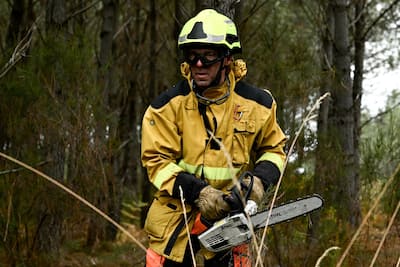
A firefighter clears brush in Saint-Jean-d’Illac, west of Bordeaux, on July 27, 2026, during forest fires in the Gironde region, southwest of France.
AFP
Météo-France, however, is forecasting a new heat wave in the southwest from Tuesday with highs of up to 40°C and slightly less strong, but drier winds.
“He really calmed down last night”, but “he could leave at any time”, confides a Gironde firefighter, on condition of anonymity.
“We looked everywhere to protect the houses, but we found nothing, the fire never happened,” he said. He was responsible for protecting peri-urban areas “to prevent homes from burning down like in Porge or Ferret”, a tourist peninsula evacuated on Friday.
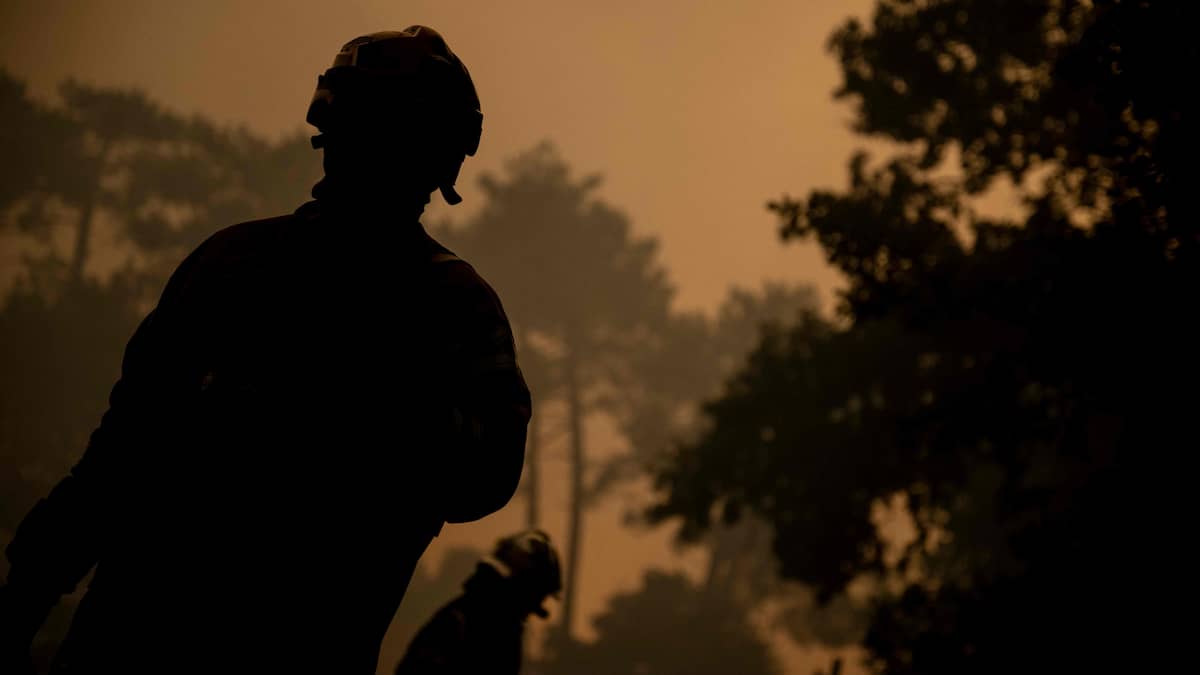
On the grounds of a school, around forty fire trucks are parked, next to tanks lent by farmers and construction professionals. Dozens of firefighters with drawn faces and tired eyes are having breakfast in the refectory.
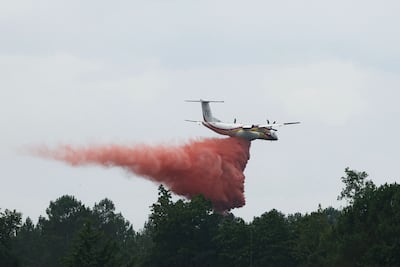
This photograph shows a Bombardier Dash 8 Q400 MR aircraft (right) dropping retardant on a forest near Marcheprime, about 30 km from Bordeaux, on July 27, 2026, as a forest fire ravages Gironde, in southwest France.
AFP
The night was also intense in the Madrid region. The first returns home are planned for Monday for the evacuees, “once the security conditions are met”, announced the prefect of the region Francisco Martin Aguirre.
In a cafe located a few kilometers north of the Avila fire, the largest in Spanish history, a firefighter told AFP early Monday that he and his team had spent the entire afternoon and night since Sunday trying in vain to put out the flames.
Forests catch fire all the more easily as European vegetation and soils have been very dry for months, a phenomenon accentuated by the exceptional heatwaves which crossed the continent in June and July and caused more water to evaporate.
And the emergency services in the Madrid region expect “wind gusts of up to 30 km/h (which) will complicate the task” during the day.
More than 13,000 businesses evacuated
The Bordeaux region, renowned throughout the world for its vineyards, is also the region in France with the most campsites; 45 establishments were evacuated, representing around 40,000 campers.
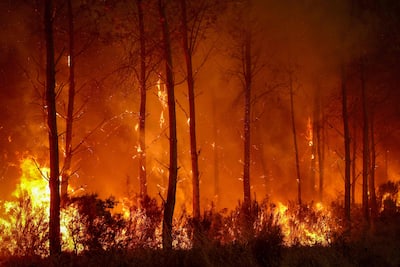
A forest fire rages in Saint-Jean-d’Illac, about 30 km from Bordeaux, on July 26, 2026, while a forest fire ravages the forest north of the Arcachon Basin (Gironde).
AFP
On the outskirts of the Arcachon basin, firefighters faced a “pyrocumulonimbus” called a “fire storm” during the night from Saturday to Sunday. The giant blaze engulfed 240 homes.
“I encourage tourists not to come, not to join the Gironde”, called the prefect of Gironde Sophie Brocas on Sunday, inviting “the tourists present to consider another destination” while local solidarity has been organized for several days.
“We must help everyone we can help to save the inhabitants, save our woods, our villages and our towns. It’s a little help in this ocean of needs,” describes Yannick Poulet, a 59-year-old territorial civil servant, among the volunteers.
In Porge, between the chic seaside resort of Cap Ferret and Bordeaux, AFP aerial images bear witness to the violence of the fire: rows of ravaged houses, charred cars and completely destroyed buildings.
Not far away, the fabric of defense industries and scientific sites around Bordeaux-Mérignac airport, with powder mills, missile factories and research centers, is now under close surveillance, exposed to the massive fire.
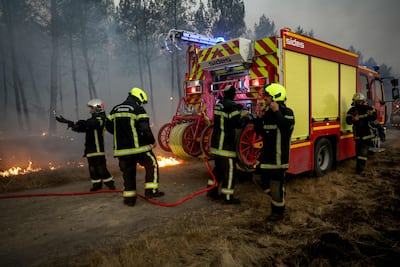
Firefighters stand near their vehicles as they battle a forest fire in Saint-Jean-d’Illac, about 30 km from Bordeaux, on July 26, 2026, while a forest fire ravages the forest north of the Arcachon Basin (Gironde).
AFP
“More than 13,000 businesses” were evacuated in the Gironde department alone and “obviously cannot carry out their normal activity,” Economy Minister Roland Lescure said on Monday.
The fire also severely disrupted transport, with a highway closed for 60 kilometers and rail traffic interrupted.
Spanish “National Pact”
In Spain, the Prime Minister, Pedro Sanchez, is due to go Monday morning to the disaster area of Castellon, near Valencia where the fire claimed a first victim. On Sunday, he renewed his call for a national “pact” against the effects of global climate change, but which primarily affects Spain.
The Avila fire, near Madrid, is the largest in the country’s recent history (25,000 ha ravaged, 60,000 people evacuated).
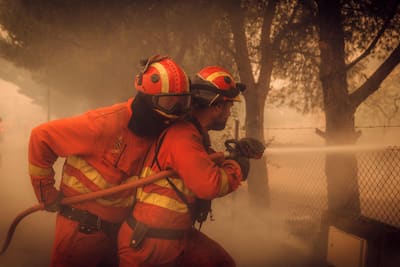
This press photo published on July 26, 2026 and taken on July 24, 2026 by the Spanish Military Emergency Unit (UME) shows members of the UME battling a forest fire near Navas del Rey, 55 kilometers southwest of Madrid.
AFP
The authorities must communicate “a timetable” for “the reopening of the El Escorial campsite which led to the evacuation of 4,500 people” and for a retirement home in San Martín de Valdeiglesias, a town located around fifty kilometers from Madrid.
“I didn’t know what to take. I thought my whole house was going to burn,” Roberto Velasco, 84, told AFP in an improvised evacuation center in a gymnasium north of Madrid, after fleeing his village, Navalagamella. He brought a small suitcase and a hard drive containing copies of old family letters and mementos of his Chilean ancestors.
“At first I thought I would take some music and some books,” he says, sitting tired-looking on a cot, wearing a dirty gray T-shirt. “But I only brought the hard drive and some clothes. I didn’t even take a towel.”