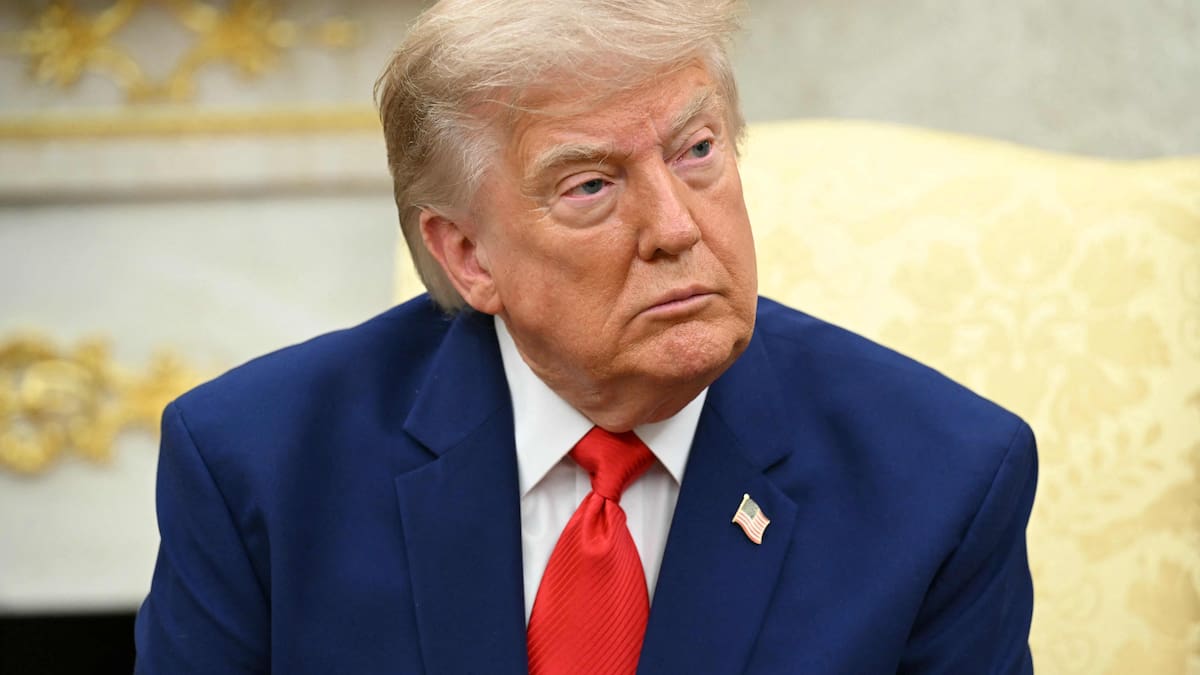

With each ship attack in the Strait of Hormuz, at the heart of tensions between Tehran and Washington, the United States will respond with strikes on Iranian civilian infrastructure, Donald Trump warned on Wednesday, despite the very high cost of the war.
The hostilities, which resumed on July 7, have awakened market concerns about hydrocarbon supplies while the strategic strait is once again blocked by Iran and Saudi ports are under the threat of a blockade from Yemeni rebels.
The barrel of Brent, an international benchmark, rose above US$95 on Wednesday for the first time in almost six weeks, far from the lull which followed the signing of a memorandum of understanding in mid-June between Washington and Tehran.
American bombings are now occurring one after the other on Iranian soil, and the economic slump is increasing in a country weakened by decades of international sanctions.
“We are still struggling to meet our most basic needs and now we must also face the ravages of war,” despairs Aïda, a 34-year-old embroiderer from Iranshahr (south-east) contacted by AFP in Paris, deploring inflation, poverty and “missiles on our cities every night”.
Early Wednesday afternoon, an American missile hit the island of Larak, located in the Strait of Hormuz, the Iranian Fars news agency reported, specifying that the authorities were trying to determine “the extent of the potential damage”. State television, for its part, reported explosions on the island as well as in Sirik, a port city in southern Iran.
During the night, the large city of Tabriz (northwest) and the province of Khuzestan, close to the Gulf, were targeted, according to official Iranian media, while explosions were reported in Bushehr (southwest), where the country’s only nuclear power plant is located.
Warning sirens also sounded in the capital Tehran and anti-aircraft defense was activated.
Screenshot | Truth Social
More than 37 billion
The American president assured Tuesday that he was “not finished at all” with the Iranian enemy.
Triggered on February 28 by Israeli-American bombings, the war is nevertheless unpopular in the United States: according to the American Minister of Defense, Pete Hegseth, it has already cost US$37.5 billion. On Tuesday, he defended the government’s request for an additional budget of US$67 billion for the Pentagon, deemed “urgent” and “necessary”.
At the heart of the dispute, Tehran’s control over Hormuz: the Islamic Republic only authorizes one route, along its coasts, threatening to attack any offending vessel, and wants to introduce service fees.
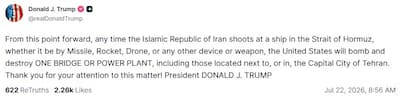
“From now on, every time the Islamic Republic of Iran fires on a ship in the Strait of Hormuz (…), the United States will bomb and destroy A BRIDGE OR A POWER PLANT, including those located near, or in, the capital Tehran,” the American president launched on his Truth Social platform on Wednesday.
“We remain open to diplomacy,” Secretary of State Marco Rubio stressed to journalists on the sidelines of a meeting in Manila. “But for now (the Iranians) don’t seem to be taking this seriously.”
Earlier, he had expressed concern about a “very dangerous precedent” in the event of Iran maintaining control over Hormuz, recalling that China, Tehran’s important economic partner, was “opposed to any form of toll or restriction”.
Since the resumption of the conflict, which shattered the ceasefire struck in April, Iran has tightened its grip on this strategic route, through which a fifth of world hydrocarbon trade passed before the war.
Houthi threats
In retaliation for American strikes, Iran retaliates every day by attacking countries allied with Washington in the region.
In Jordan, the army intercepted Iranian missiles and drones, while the Revolutionary Guards, Tehran’s ideological army, said they had targeted American bases there. As a result, the European Union (EU) has advised European airlines against flying over Jordan.
Warning sirens also sounded in Bahrain, where an AFP correspondent heard an explosion.
On the other side of the Arabian Peninsula, the Yemeni Houthi rebels announced, after exchanges of fire last week, a blockade of the ports of Saudi Arabia, the world’s leading exporter of crude oil. Like during the Gaza war, when they carried out drone and missile attacks in the area.
Maritime security firm Vanguard Tech on Tuesday identified for the first time at least two vessels loaded with Saudi crude turning back in the Red Sea.
Pakistan, the mediating country between Tehran and Washington and where the Iranian Interior Minister visited earlier this week, said it was “deeply concerned about attempts to drag the Kingdom of Saudi Arabia into the conflict”.