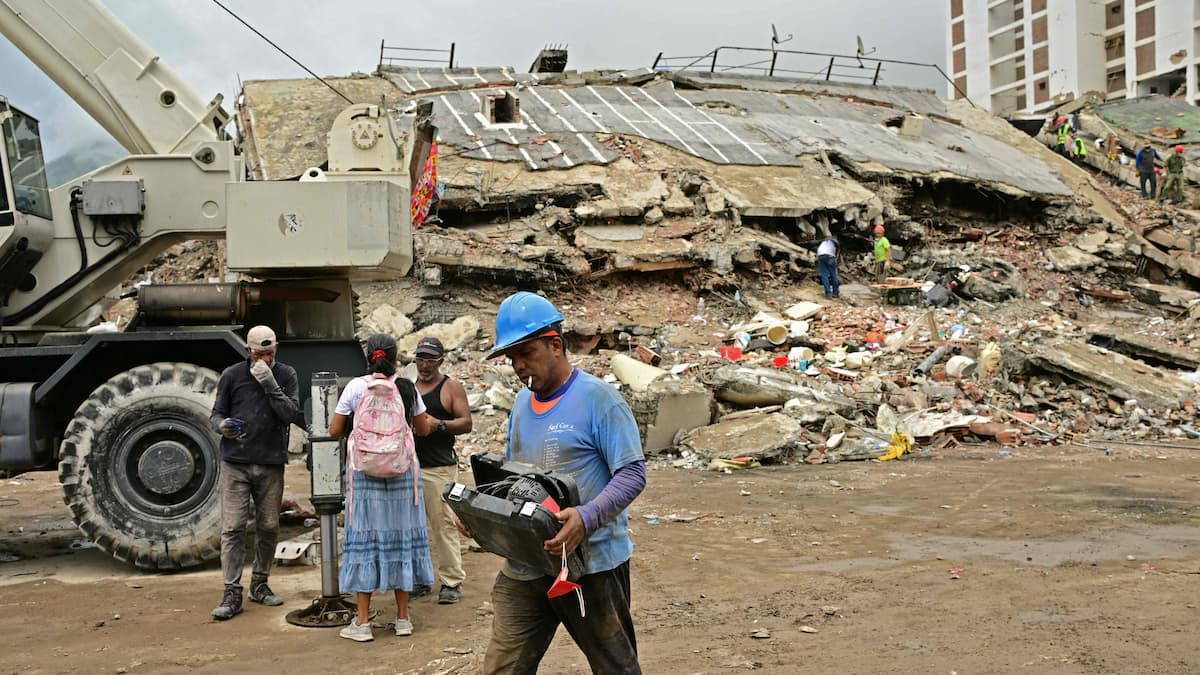

Braving possible landslides, Miguel Baez infiltrates through a narrow tunnel between the ruins of a building which collapsed in Guaira, during the double earthquake in Venezuela, the death toll of which exceeded 4,000 and thousands missing.
• Also read: The death toll from the double earthquake in Venezuela is close to 4,500
Driven by the desire to find his loved ones among the corpses while risking his life in unstable tunnels, he saw the horror: dead people, dismembered bodies.
Miguel Baez believes his missing mother Solangel, brother Hector and niece Susej were stuck in a 12-story public housing complex where he lived in Caraballeda.
“I want to stay here until the end,” he said. “At least, find them to give them a burial as they deserve,” he adds with a dull look.
Thin with brown skin, he wears a blue helmet and a black polo shirt soiled by dust kicked up by an excavator a few meters away. He walks nimbly over inclined concrete slabs to a hole from which volunteers like him take out buckets full of rubble.
A 32-year-old trader, he became a first aid worker. He has received no training, but his will is law.
“Fight and save people”
Like him, thousands of volunteers mobilized to compensate for the authorities’ lack of presence. And he also released images of his loved ones with the words “missing” and contact numbers in vain.
Search dogs sniffed the area, rescuers from Brazil, the United States, Mexico, Honduras and other countries scanned the rubble. But no signs of life were detected.
Miguel Baez lost hope of finding his loved ones alive after the tenth day. “You try to fight, to put yourself in danger, to save people, and then you come across corpses,” he says, referring to having seen “living people” taken out of the rubble but also “several decomposing bodies”.
When he moves away from danger, death pursues him even in his sleep: “Fatigue, stress brings you to this. It’s a trauma, it’s psychological,” he analyzes.
An image of Jesus Christ greets rescuers at the shattered entrance to two towers known as OPP 33. The buildings are now a millefeuille of ceilings and floors coated in the smell of putrefaction.
Miguel Baez recovered a piece of painting from his apartment 101. He found the guitar of Hector, 28, and the viola of Susej, 10. Both were musicians.
But almost three weeks after the tragedy, their bodies have still not been found.
Three nights ago, rescuers extricated the body of a little girl. “Obviously we got up, desperate, running,” thinking that it could be his niece, the daughter of his sister Jesurimar. “The child was crushed from the knees upwards, we could see the trunk. We saw how she was dressed. It wasn’t her,” he says.
The eldest of five siblings moves away from the search perimeter at times to “try to relax” and avoid showing himself as he is: “devastated”.
The replica trap
Since the first day of the disaster, his routine has consisted of sleeping a few hours and waking up “thinking about what happened, who worked that night, what body was found.”
Miguel Baez climbs the concrete embankment of what was the sixth floor, to the gallery less than a meter in diameter opened with a sledgehammer and a jackhammer.
He filmed a video with his cell phone in the bowels of the building where he went down several times. We see men weaving between slabs supported by thin pieces of rubble. The space is so narrow that they can only move forward by crawling.
He says that once inside, he was surprised by one of more than a thousand aftershocks from the powerful double earthquake of June 24.
“We were on the 2nd floor, heading towards the 1st,” when the structure “gave way.” “We had to go out because otherwise, well…” he says without finishing his sentence.
“God protected us,” he continues.
At the time of the earthquake, Miguel Baez was on a bus in Maiquetia, the city of the now partially closed international airport. He was only able to reach the rubble of what was his home for 13 years in the middle of the night and remembers “people running, screaming in despair”.
Since then, “we have nothing, we don’t know what tomorrow will bring,” he laments, spending the nights in tents with other members of his family.
All around, heavy machinery is moving the rubble, and in this smell of putrefaction, flies are constantly circling.
“When you eat, there are flies that land on the food, after having landed on the corpses,” says Miguel Baez, aware of being exposed to the risk of disease.
The rain interrupts search operations and Miguel Baez takes shelter in his camp. On his cell phone, he looks at photos of moments spent with his mother Solangel, 48 years old: Mother’s Day, family outings.
Tears well up in his eyes without falling down his cheeks, emaciated by fatigue: “We hardly have any tears left to express what we feel.”