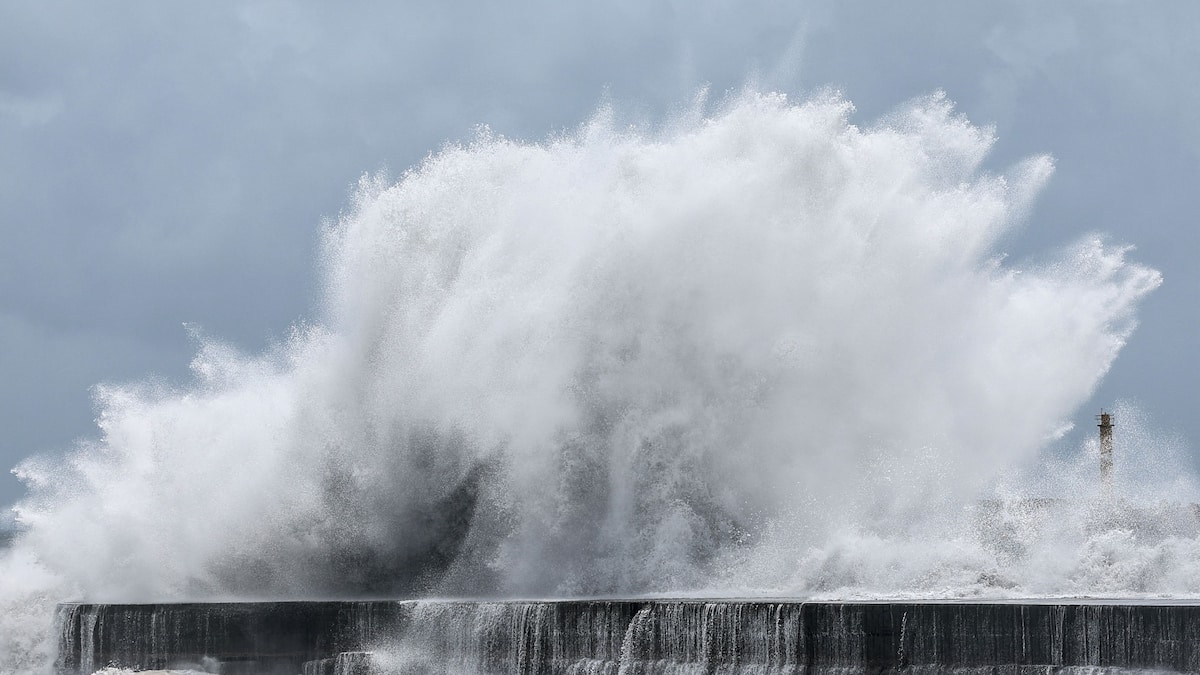

Five people have been killed following a landslide in the Philippines and more than a thousand people have been evacuated in Taiwan and many schools and offices are closed in the face of the arrival of the biggest typhoon the region has seen in decades.
• Also read: Taiwan prepares for its biggest typhoon since 1995
• Also read: Super-typhoon “Bavi” causes “major damage” to the American island of Rota
Typhoon “Bavi”, which has already hit several Pacific islands, is expected to hit northern and eastern Taiwan on Friday and Saturday, as well as the southern islands of Japan, before hitting China.
A landslide caused by heavy rains, aggravated by the passage of storm “Bavi”, left at least five dead and six missing on the island of Mindanao, in the south of the Philippines, local police said.
In Taiwan, where the typhoon has yet to make landfall, residents of the port city of Keelung are stocking up on food, taping windows and piling sandbags in front of stores, as recommended by authorities.
“They say it’s going to be huge, of course it’s scary, isn’t it? » Chang Shih-huo, 76, owner of a grocery store in Keelung, told AFP.
“We stocked up on instant noodles, bread and other such items. As soon as the wind and rain really start to get stronger, we’ll have to close the shop. »
After bringing destruction to the islands of Guam and the Northern Mariana Islands as a super typhoon, “Bavi” was downgraded to a typhoon. It now displays gusts of 198 km/h, according to the Taiwan Meteorological Agency (CWA).
With a radius of strong winds extending 380 kilometers, it was the largest typhoon to hit Taiwan since 1995, when measurement methods changed, according to the CWA.
“The typhoon is expected to continue to weaken as environmental conditions are not favorable for it,” said Wang Ping-hsiang, a forecaster at the CWA.
Stay on “high alert”
Taiwanese President Lai Ching-te urged residents in areas likely to be most affected by “Bavi” to remain on “high alert.”
“Although the typhoon has weakened slightly and is now classified as a moderate typhoon, its broad wind field could still bring strong winds and heavy rain to various areas,” it said on Facebook.
More than 20,000 military personnel, as well as machines, equipment and vehicles, were ready to respond in the event of an emergency.
One meter of rain is expected in Taiwan as “Bavi” passes, sparking concerns about the risk of flooding and landslides.
More than a thousand people were evacuated from their homes, almost all residents of eastern Hualien County, where authorities monitor two reservoir lakes in the mountains.
Work and classes were canceled for the day Friday in eight counties and cities in northern and eastern Taiwan, including Taipei, the government announced.
“What you are seeing right now is the most remarkable sight we have seen in ten years,” said Penny Pan, 48, a restaurant owner in Keelung, as her husband placed sandbags at the entrance to their establishment.
“Before, we never used sandbags to prepare for typhoons. But this time, gusts of force 10 are forecast, so the captains and fishermen have all told us that we need to be better prepared,” she explained.
Warming oceans promote the intensification of tropical storms and increase humidity, which can turn into heavy rains.
The oceans have just experienced their hottest month of June ever observed, under the combined effect of El Niño and climate change, according to the European Copernicus Marine Observatory.