

The United States has seen a significant and unusual increase in cases of cyclosporosis near the Canadian border, a parasitic infection that can cause severe gastrointestinal upset for up to six weeks.
• Also read: Stubborn gastro that lasts several weeks: how to protect yourself from the parasitic epidemic in the United States?
• Also read: ‘Excrement splashes’: Cyclists fall ill due to cow dung on roads during race
This infection is caused by a microscopic parasite, Cyclospora. It is contracted by consuming water or fresh foods contaminated with human feces containing eggs of the parasite, such as raspberries and other berries, bagged salad, cilantro, basil, or snow peas.
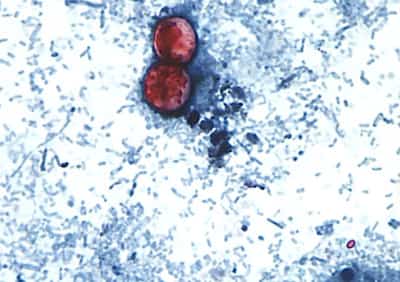
le Cyclospora
CDC
While Michigan usually only records around fifty cases per year, the state bordering Ontario has reported nearly 1,000 infections since June 22, CNN reported Wednesday. Of this figure, more than thirty patients had to be hospitalized.
The Centers for Disease Control and Prevention (CDC) and the Food and Drug Administration (FDA) are monitoring several sources of contamination in Illinois, Ohio, New York, Pennsylvania and Texas, according to the American media.
These cases could be linked to Mexican food restaurants, a supermarket chain and a catered event, linked to white onions, cucumbers and cilantro.
Fast food giant Taco Bell has also removed several ingredients from its menu in connection with the spread of the parasitic infection.
Notices have been posted in several locations across the United States, noting that they will not serve lettuce, pico de gallo, guacamole or cilantro onion.
The problem is that it is particularly difficult to attribute this disease to a source, since the parasite’s DNA evolves from generation to generation, unlike E. coli and Salmonella bacteria which remain very similar when they multiply. This makes the strain responsible for an outbreak harder to trace.
Symptoms
Infected people face symptoms similar to severe gastroenteritis: frequent watery diarrhea, major abdominal cramps, bloating and nausea, detailed the New York Times Wednesday.
The incubation period can vary between two days and more than two weeks. In healthy adults, the illness can resolve on its own in about a week… but can also last for six weeks without treatment, Dr. Rebecca Schein, an infectious disease specialist at Michigan State University, told CNN.
In those with compromised immune systems, symptoms may persist until the disease is treated with antibiotics, she added.