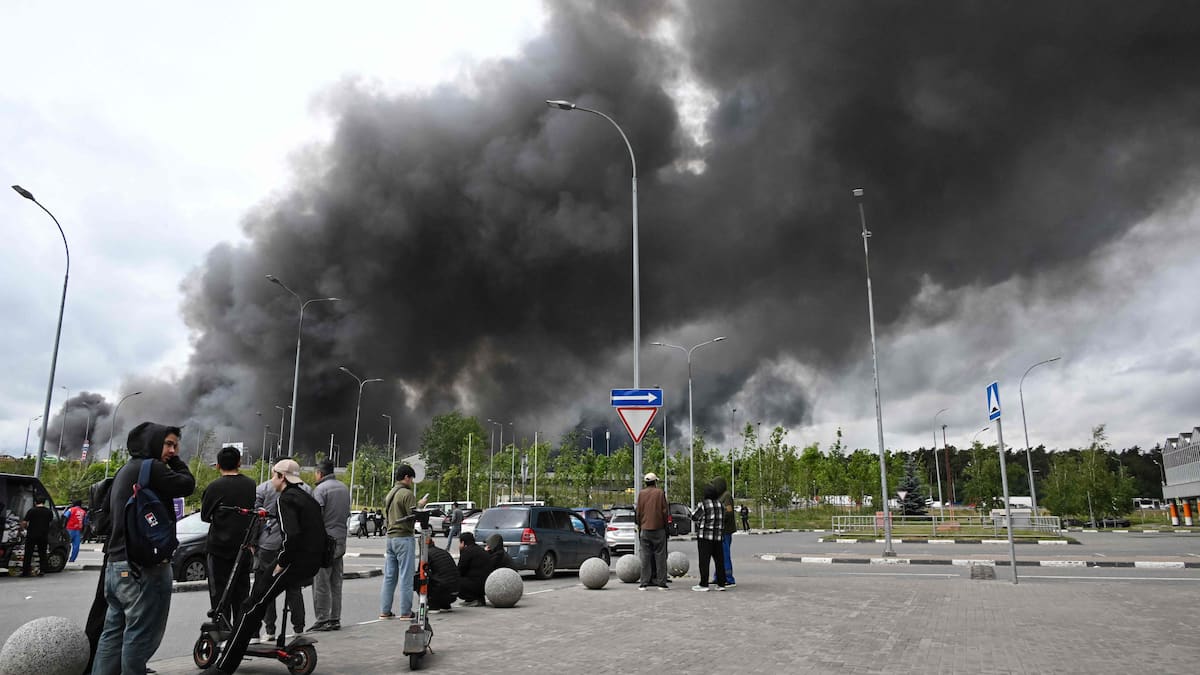

The Ukrainian drone attacks appear to have prompted Russia to change its military strategy.
• Also read: Four dead in Ukraine, five in Russia and occupied territory after night strikes
• Also read: Alliance Summit: NATO and Canada to commit €70 billion in military aid to Ukraine for 2026-2027
• Also read: At least 27 dead in Kyiv in worst Russian strikes on Ukrainian capital
During the night from Thursday to Friday, Moscow carried out strikes in residential areas of Kyiv. According to the doctoral student in political science at Sciences Po Paris, Georges Mercier, these “terrorist” attacks prove that the Russian army is struggling to make progress on the ground.
“What is interesting is that Ukraine, in the last months and in the last year, has managed to build, on its own initiative, a fairly autonomous drone industry which allows it to strike in Russia. That is to say that for the first time in the conflict, the Russians themselves feel attacked and feel the repercussions of the war,” explained the political analyst in an interview with LCN on Friday.
Many Russians now have to queue to put gasoline in their cars, even though Russia is a major energy exporter.
Lines of cars in front of several gas stations in Moscow, Russia, July 3, 2026
AFP
“This is not a normal situation. This shows us that the Ukrainians are succeeding in inflicting a cost on the Russians and it is in response to this that Vladimir Putin orders terrorist strikes. It is perhaps the case to say this because we are attacking civilian infrastructure in an attempt to attack Ukrainian morale,” maintains Georges Mercier.
Ukraine relies heavily on support from NATO, a summit of which is planned for next week. President Volodymyr Zelensky notably requested more interceptors to counter Russian ballistic missiles.
In the meantime, the Ukrainian army is expected to continue its strikes against Russian energy infrastructure.
“Ukraine is in an asymmetrical war strategy, much like the Iranians were in relation to the United States. Basically, Ukrainians have fewer resources, less capital, less population than Russians. In a war of attrition, of killing as many people as possible, the Ukrainians could resist for less time,” explains the doctoral student in political science.
“But what they are doing at the moment is attacking logistical sources, the very functioning of Russia so that the Russians understand that this war concerns them too. While in the first three or four years, the Russians were quite isolated from the conflict and Russian propaganda managed to make them believe that there were gains, now what we see is that there are no more gains,” he adds.
To see the full interview, watch the video above.