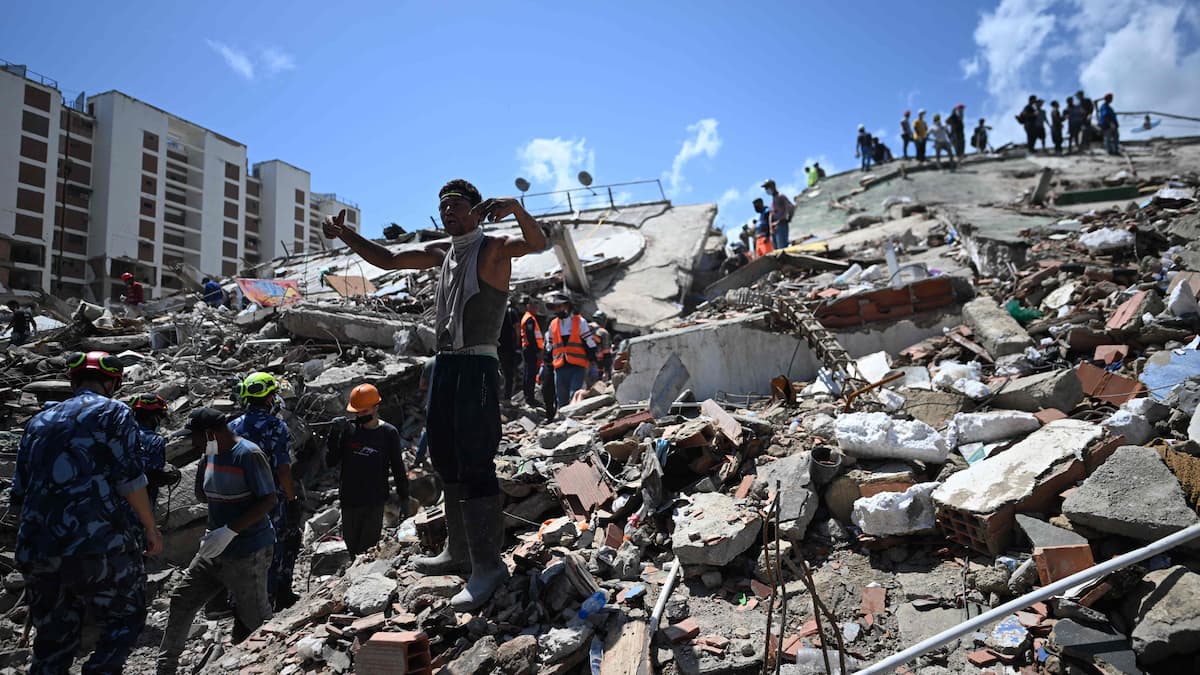

Hundreds of rescuers are working Thursday to extract a forty-year-old stuck for eight days in the rubble of a building in Venezuela, after the double earthquake which left more than 2,000 dead and tens of thousands missing.
• Also read: The Venezuelan diaspora grieves remotely, searching for loved ones online
• Also read: Earthquakes in Venezuela: the toll on the rise with 2,295 dead and more than 11,000 injured
• Also read: Earthquakes in Venezuela: new toll of 1,943 dead, 10,500 injured and more than 6,000 people rescued
Hernan Gil, a 43-year-old security guard, remained stuck in his gatehouse, under the building where he worked in Catia La Mar, a coastal area of the state of La Guaira (north) almost completely destroyed during the natural disaster of June 24 which left more than 2,000 dead and tens of thousands missing.
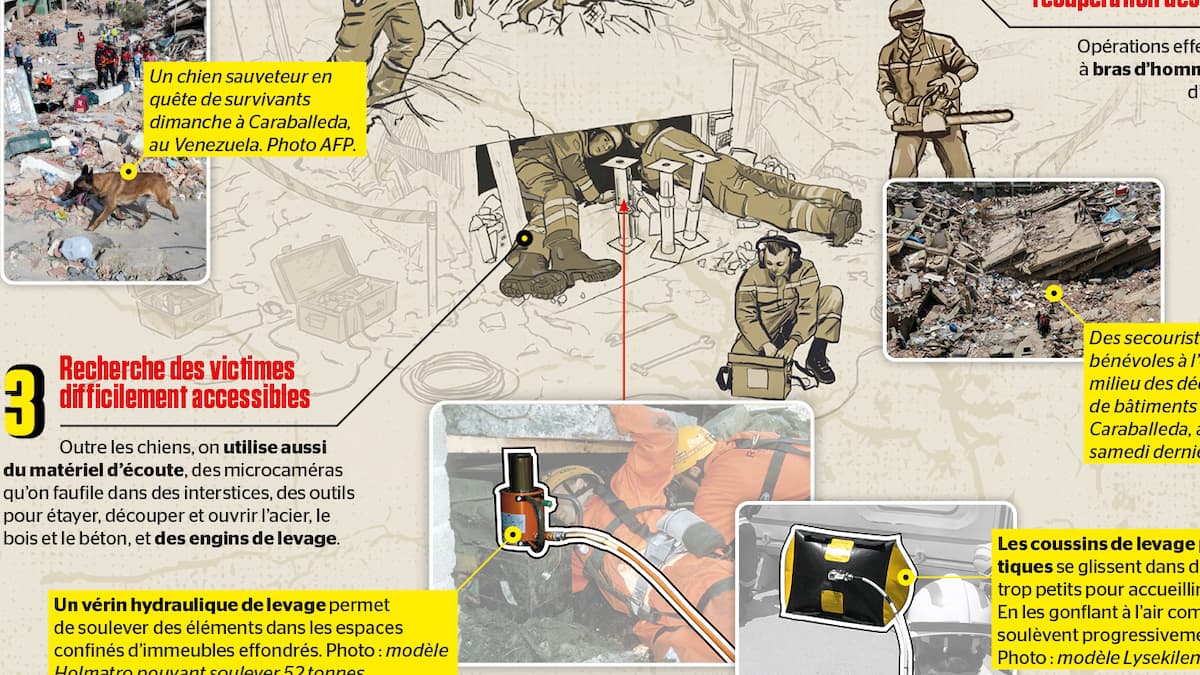
And rescue teams from seven countries – Venezuela, Chile, the United States, Portugal, Costa Rica, El Salvador and Mexico – have been working tirelessly for three days to reach him, after the alert launched by passers-by who had heard him.
On Wednesday, relief efforts progressed via two distinct routes, simultaneously. “It is a structure whose access is particularly complicated,” Cristian Vera, head of the USAR team of the Chilean firefighters, explained to AFP. “It’s complicated to reach the precise location where the victim is located.”
Information emerges, contradictory. Around 7:00 GMT, an American sent a message: “we’re almost there”. Two hours later, a manager admitted: “Not yet, we have to wait.”
At the start of the night, the rescuers were almost a meter from the miracle victim. Chilean firefighters posted a video on Instagram showing him inside the gatehouse, turning his head to look at the camera, his right eye bloodshot.
“It’s truly a miracle,” said Gil’s wife, Gusbimar Gonzalez. “I am completely amazed, because this is the first time I have seen so many countries come together to save a single person.”
Venezuela’s interim president, Delcy Rodriguez, declared a seven-day national mourning “in tribute to the memory of the victims.”
Their number was revised upwards with 2,295 dead and more than 11,000 injured, according to the President of the National Assembly Jorge Rodriguez. But the disaster has not left all its victims: the United Nations estimates that 50,000 people are missing.
– D for deceased –
There have been a handful of miraculous survivors, like this three-year-old boy found alive Tuesday, six days after the most powerful earthquake Venezuela has seen in more than a century.
But experts say victims trapped under collapsed buildings are unlikely to survive beyond 72 hours. Standing in the middle of the ruins of Caraballeda where his son disappeared, in the state of Guaira, José Rafael is categorical: “No one will leave here, alive or dead”.
Dozens of destroyed buildings bear a large spray-painted letter D. Meaning “deceased”, according to the international nomenclature for search and rescue operations during earthquakes, it puts an end to hopes of finding survivors.
In a country already subject to information restrictions in recent years, the government limited access to La Guaira after the tragedy by requiring volunteers to have a pass.
“It was extremely difficult to reach Venezuelan territory,” laments Luis Arteaga Benatuil, a member of the Spanish search and rescue group USAR 13. “We arrived late, but our goal remains to save lives.”
– four police officers arrested –
The scale of the material damage plunged part of the country into chaos. The Venezuelan authorities have set up aid distribution centers but survivors feel more supported by foreigners and volunteers.
Four Venezuelan police officers were arrested for looting in the twin earthquake zone, according to the Justice Ministry, after the post went viral of officers caught red-handed by furious residents.
In the state of La Guaira, “food shortages are widespread, basic services have collapsed and communications are largely cut,” said the United Nations High Commissioner for Refugees (UNHCR). “Tensions within the population are increasing, while access to aid remains limited.”
Fátima Berroterán, 56, lived in one of the 20 towers of the Brisas de Maiquetía residence. She and her family sleep in the parking lot. “Here, nothing happened to us. It’s only since that night that they started bringing us water,” she explains.
The World Health Organization (WHO) fears epidemics and is concerned about “inadequate” systems for tracking the missing and recording victims.
Disruptions to health services, water and sanitation networks, combined with population movements, could promote outbreaks of “vaccine-preventable diseases such as measles, diphtheria and whooping cough,” warned a spokesperson for the organization, Christian Lindmeier.