
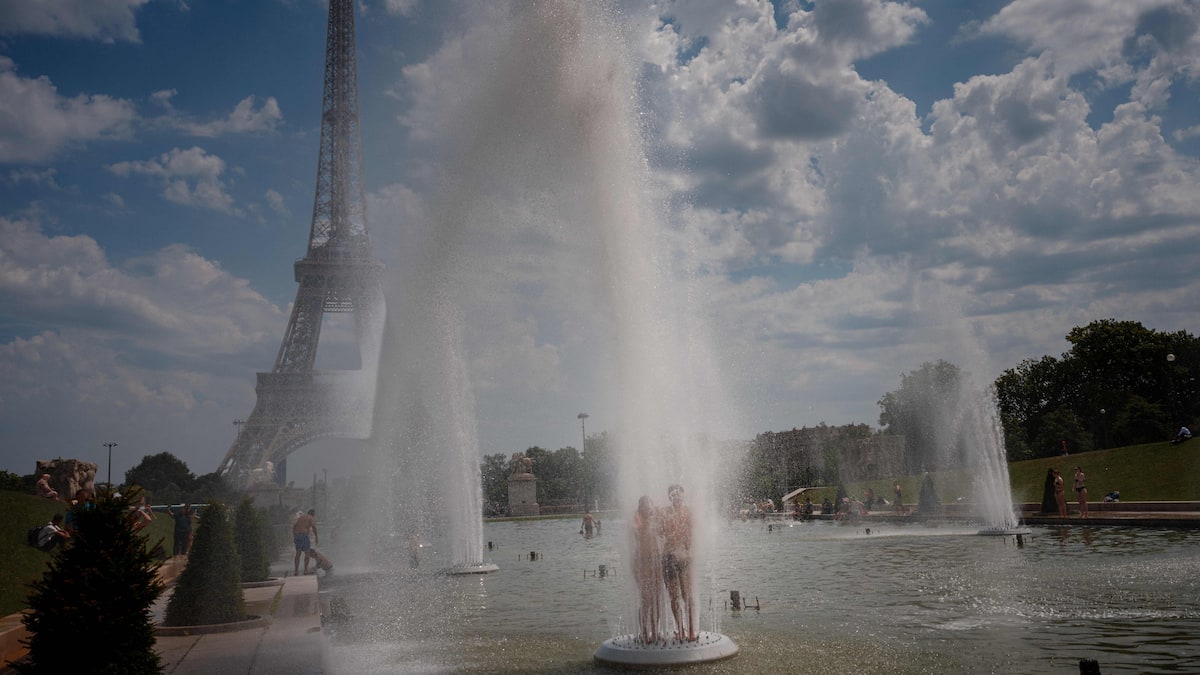

Much of Europe, from France to the Balkans, faced another suffocating day on Saturday, with absolute temperature records broken from Germany to Denmark, putting strain on health systems.
• Also read: Many dogs and cats die due to heatwave in Europe
• Also read: Climate change, “unequivocally” culprit of the intense heatwave in Europe
• Also read: 18-month-old baby dies after being found in car during heatwave in Marseille
With the heat wave moving towards the north-east of the continent, maximum alert is also on the agenda in Switzerland, Germany, Austria and Hungary.
At least 193 million people in Europe, including 75 million in Germany, experienced temperatures above 35°C at some point on Saturday, according to AFP calculations, up from Friday.
And the historical records have piled up: Denmark has never been so hot since the creation of weather records in 1874, with a temperature rising up to 37°C.
The Czech Republic recorded its absolute temperature record at 40.6°C. Germany also set a new record on Saturday, with 41.5°C.
Emergency services are increasingly overloaded in cities like Cologne. “After ten consecutive days of extreme heat and without notable nighttime cooling, the situation is serious,” noted the city administration.
In the last 24 hours alone, seven people were found unconscious in their homes, mainly under the roofs.
Across Europe, all means are good for gaining a few degrees: taking refuge in a church, sleeping in your cellar or by the river, cooling off under a fountain, or even, like the Frenchwoman Nathalie, spending “a few hours at Picard”, the brand specializing in frozen products.
Even Paris men’s fashion week, which ends on Sunday, is affected by the heatwave, with controversy surrounding a gigantic artificial wave at the Louis Vuitton fashion show. Many Internet users have denounced the waste of water. But LVMH, owner of Louis Vuitton, assured that the water would be “reinjected into the sanitation network”.
Meanwhile, while Munich Pride has been maintained, Paris is deprived of an LGBT+ Pride March. And the cancellation of the Solidays music festival, which was to take place there until Sunday, will deprive the organizing association Solidarité Sida of 3 million euros to carry out programs to fight the disease.
Jump in emergency calls
In Germany, Hamburg will not see its half marathon held either, while the cycling course and the Frankfurt Ironman race have been shortened.
The prestigious Berlin Philharmonic is relaxing its dress code due to the 41°C expected during the day: men can take off their jackets and will be allowed to roll up their sleeves.
In Hungary, the army was mobilized to distribute thousands of bottles of water during public events organized in small towns across the country.
In several countries, the climatic phenomenon and its attendant pollution have put health systems under pressure. In the Paris region, calls to emergency medical aid services have jumped by 80% over the past week.
Saturday morning, the deputy mayor of Paris, responsible for health, Antoine Alibert, indicated that Parisian hospitals were subject to “exceptional and unprecedented saturation”.
It can be read very concretely in “the stretchers which accumulate in the corridors”, said the elected official, adding: “We are in the middle of a health crisis. It is an exceptional and extreme heatwave phenomenon” worsened by a “peak of ozone pollution”.
The two funeral homes in Paris have been full since Saturday morning.
The authorities have reported more than 200 deaths in Spain and others in the rest of Europe: elderly people, chronically ill people, children, adolescents, people on the streets. Heat kills, by drowning, hyperthermia, heart attack…
Reflux in France, “tropical nights” in Romania
The World Meteorological Organization (WMO) deemed it “possible” on Friday that this heat wave is an unprecedented phenomenon in terms of its scale, even if it is still premature to say so.
Repeated heatwaves are an unequivocal marker of climate change, caused mainly by the burning of fossil fuels by humans.
Its effects are innumerable: shutdown of nuclear power plants, such as at B8G77T3 in Switzerland; overheating lagoons in the Po delta in north-east Italy, very rapid melting of the Rhône glacier in Switzerland…
The ebb is nevertheless becoming clearer in France, with the expected end of maximum vigilance on Sunday evening and an entry of “fresher air” from the west and northwest. In Germany, “a respite” is also expected from Monday, with temperatures below 30°C.
In the east of the continent, Romania is preparing to issue red alerts from Monday across almost its entire territory, with the national weather service forecasting “extreme temperatures” and “tropical nights” until July 1.
Neighboring Moldova will ban the circulation of vehicles exceeding 12 tonnes between 10 a.m. and 8 p.m. on national roads between June 28 and July 1.


