
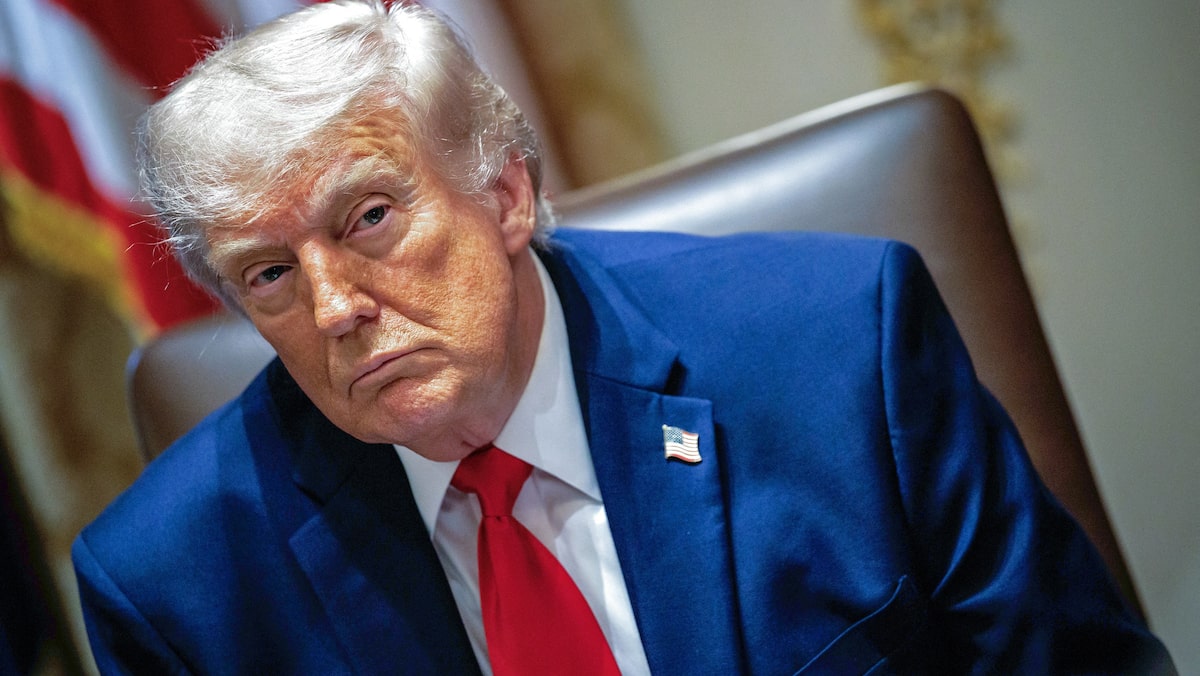

Donald Trump on Monday urged Iran and Israel to stop shooting “immediately”, after the resumption of direct attacks between the two countries for the first time since the truce concluded two months ago.
After 100 days of war and the entry into force on April 8 of a fragile ceasefire, explosions and alerts rang out again in Tehran or Tel Aviv without any injuries being reported at this stage.
Since Sunday evening, Iran has fired around thirty missiles against Israel according to an Israeli military official, in response to an Israeli strike against the southern suburbs of Beirut, a stronghold of pro-Iranian Hezbollah, in which two people died and 20 were injured.
These shots are a “warning” for Tehran which threatens a “broader response”, while the Islamic Republic considers the two fronts of the conflict inseparable.
But Donald Trump, who has not hidden his disagreements with Israeli Prime Minister Benjamin Netanyahu in recent days, slammed his fist on the table.
“Israel and Iran must immediately stop ‘shooting’,” urged the American president on his Truth Social network, who is seeking a way out of a very unpopular conflict in the United States, as the mid-term elections approach.
Relive it all
In Tel Aviv, Hillary Shaw, 68, took refuge in the shelter of a store, because she did not have one at home, and “hopes that Trump will intervene with Netanyahu so that this does not last long”.
“Not very fun to wake up so early in the morning and relive all this, without knowing how long it will last or what is happening,” agrees Jonathan Ariel. “Last time, we thought it would be short and it lasted a month,” sighs the thirty-year-old.
Daily life is once again disrupted in Israel: schools closed, transport disrupted. Near Jericho in the occupied West Bank, an AFP photographer saw a missile embedded in the ground on a desert hillside as two Israelis inspected it.
In Tehran, a powerful explosion was heard in the morning by an AFP journalist, shaking the premises of the Ministry of Foreign Affairs, where he was attending a press conference. According to the Iranian Mehr news agency, it was a drone “belonging to the American-Zionist enemy” which was shot down.
Airspace in western Iran was closed and flights at the capital’s two airports suspended.
Traffic was lighter than usual in the capital, with some residents appearing to have stayed at home while others took precautions by queuing to fill up with gas. The Iranians say they are exhausted by this conflict triggered on February 28 by Israeli-American strikes.
“The economy is paralyzed, society is suffering from post-traumatic stress, morale is at its lowest. No one knows what tomorrow will bring,” laments Farhad, a 35-year-old chef.
“Affected” talks
A few hours earlier, Iranian state television had reported explosions in Tehran, Tabriz (northwest) and Isfahan (center).
A petrochemical factory in Mahshahr (southwest) was damaged and its staff evacuated, according to Iranian media.
In response, Iran says it launched strikes against an Israeli petrochemical complex.
The judiciary warned that the publication of any images of sites affected by the strikes would be subject to prosecution. Israel, for its part, indicated that it had struck and destroyed defense systems in Iran.
“No self-respecting country would tolerate such an attack,” Israeli Ambassador to the United States Yechiel Leiter commented on X. If skirmishes have taken place in recent days around the Strait of Hormuz between the United States and Iran, this is the first time that there have been reciprocal attacks on their soils between Iran and Israel since the ceasefire of April 8.
This resumption of hostilities will “affect” talks with the United States even if negotiations via the Pakistani mediator continue, assures Iranian diplomacy, which was confirmed by Donald Trump, regretting that the process is slowed down by “ignorance or stupidity”.
The Middle East “does not need an escalation”, regretted the head of diplomacy of the European Union Kaja Kallas, while Beijing said it was “deeply concerned”.
Oil on the rise
Fueling fears of a further extension of the conflict, the Houthi rebels of Yemen, allies of Iran, for their part claimed an attack against Israel from Yemen and decreed a ban on Israeli navigation in the Red Sea, another strategic maritime route.
In this febrile context, oil prices, which have already soared in recent weeks due to the blockage of the Strait of Hormuz, were climbing: around 4 a.m., the barrel of Brent, the European benchmark, rose 4.90% to $97.65.
And the world stock markets were moving in the red in the face of this “fragile and unpredictable situation”, according to a financial analyst. These attacks further remove the prospect of a possible agreement to end this war.
Especially since beyond Lebanon, the sticking points remain numerous: control of the Strait of Hormuz (essential for the hydrocarbon trade), the Iranian nuclear program and its stock of highly enriched uranium or the fate of Iranian assets frozen abroad under the effect of sanctions.

