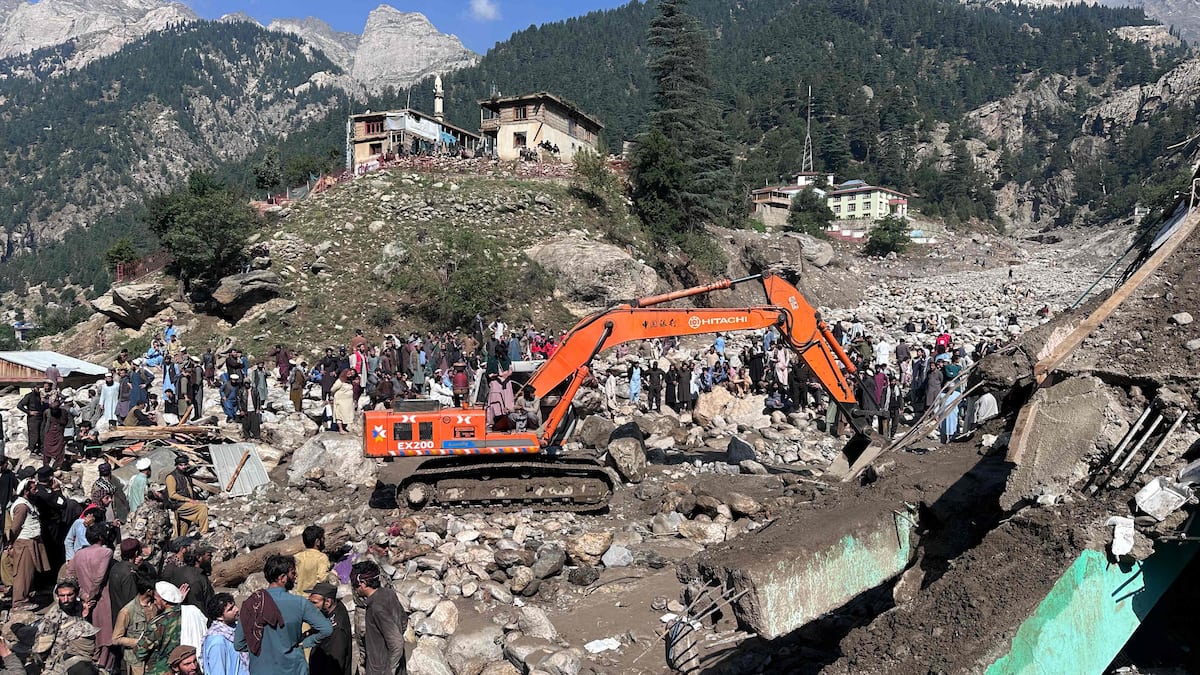

Rescue workers and dozens of residents are searching the mud and rubble on Tuesday to try to find the bodies of around a hundred people who went missing in the deadly floods which hit a remote region of northeastern Afghanistan the day before.
• Also read: In Pakistan, monsoon kills more than 160 people in 24 hours
• Also read: Afghanistan: 60 dead in three weeks in bad weather
There are few excavators and most men use shovels or their bare hands in the town of Parun, an AFP correspondent noted on Tuesday.
According to the latest report given by the governorate of Nuristan, a mountainous and difficult to access province bordering Pakistan, 23 people died in these brutal floods. Around a hundred people have not given any sign of life since Monday evening, although emergency services consider it unlikely to find survivors.
“The flood was sudden and the water level too high. No one in the area imagined that the water would rise so high. Rescuers are trying to find the bodies of people who lost their lives,” Afghan Red Crescent spokesperson Juma Khan Nayel told AFP.
“People thought that there might still be survivors in a building, but when the rescuers arrived, there was no one alive,” he added, specifying that mobile teams and clinics were on their way to reinforce the fifty Red Crescent volunteers who had been working since the day before.
Nestled in a valley on the banks of a river, the town of Parun, the provincial capital, was particularly hit. The raging floods swept away many shops and buildings in the city center, according to an AFP correspondent.
Near the central bridge spanning the river, the desolation is total: the food shops, a hotel and several buildings have disappeared. All that remains is a pile of bricks, stranded rocks and a thick layer of mud.
“Traumatized”
“I have seen a lot of floods in Parun, but I have never seen one this dangerous. I injured myself while trying to escape higher up the mountain, it was raining, it was difficult to climb, I injured myself,” Farid Gul Zaheer, a 34-year-old pharmacist, told AFP.
“When I turned around, the town had been destroyed,” he adds, specifying that he had lost his pharmacy, “the fruit of a lifetime’s work.”
“Everyone is scared, people are traumatized, no one has slept,” he continues.
“The flood only lasted a few minutes,” said Zakirullah Zaki, 29, manager of the Spogmai hotel near the river. His family was lucky, his little brother, who had disappeared, was able to be found.
Soldiers were sent as reinforcements, according to the government.
The various UN agencies present in Afghanistan are meeting on Tuesday to prepare a mission to assess the damage in Nuristan, the spokesperson for the Office for the Coordination of Humanitarian Affairs (OCHA) Olga Cherevko told AFP on Tuesday.
“We must urgently distribute food aid,” said the Red Crescent, as well as drinking water.
Families are also left homeless, and tents will be needed to house them in the short term and then help so they can rebuild their homes, added Juma Khan Nayel.
Afghanistan generates only 0.08% of greenhouse gas emissions responsible for global warming, but is on the other hand one of the countries most affected by the devastating effects of climate change, according to the UN.
“Water resources have been affected, glaciers are melting and flooding has increased”, which “contributes to the humanitarian crisis in the country”, recalled in early July the director of the Afghan Environmental Protection Agency (GEPA), Mati-ul-Haq Khalis.
Deadly floods also left 12 dead, including five children, on Monday in Pakistan, in the northern province of Khyber Pakhtunkhwa, neighboring Afghanistan, according to the Regional Emergency Situations Agency.
More than 200 people died in the spring in Afghanistan and Pakistan due to precipitation and floods.