
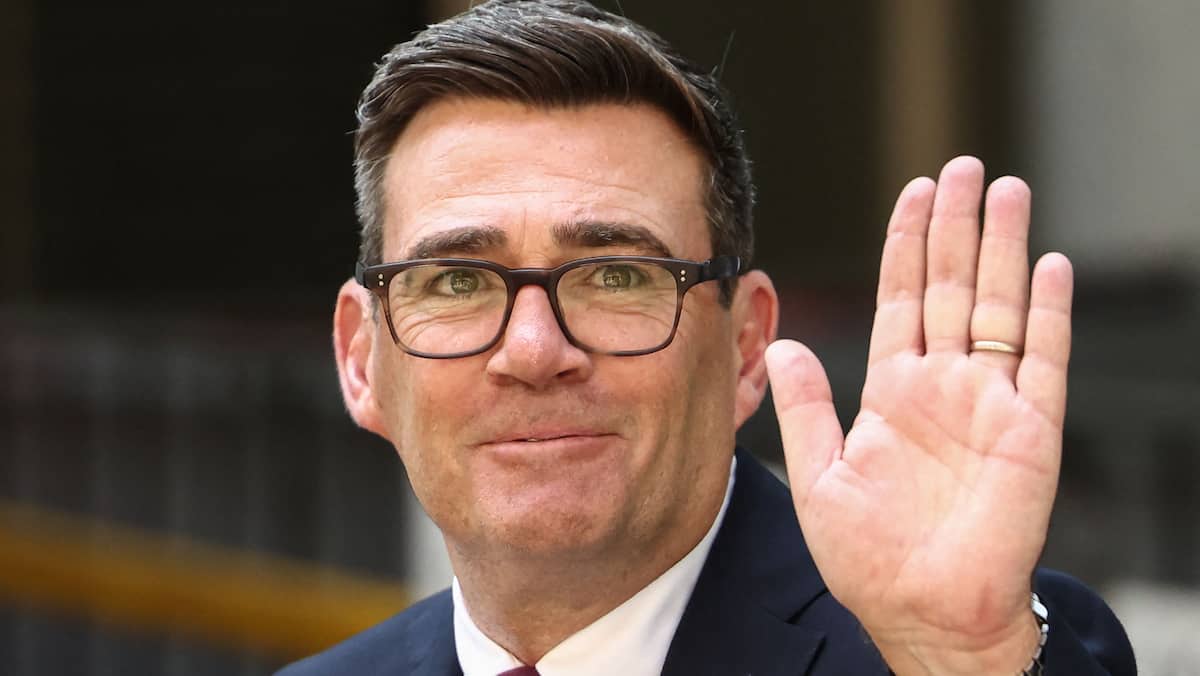

Andy Burnham was inaugurated as leader of the Labor Party on Friday, pledging to “restore hope” to the British before his installation on Monday in Downing Street, where he will succeed resigning Prime Minister Keir Starmer.
• Also read: British Prime Minister Keir Starmer announces his resignation
The former mayor of Greater Manchester, one of the country’s most popular politicians, was the only candidate standing to succeed Keir Starmer, who announced his departure on June 22.
Andy Burnham, 56, won the support of around 95% of Labor’s 403 MPs, as well as that of the party’s 11 unions.
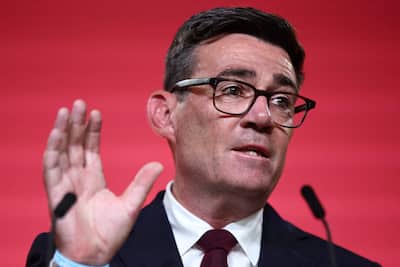
During his first speech as leader at the premises of the TUC trade union confederation in London, where he appeared smiling and relaxed, he promised voters to take “a new path, different from the one we have been following for forty years”, with “an economy and a country that works for all its inhabitants and all its territories”.
AFP
Andy Burnham promised to “restore hope” and embody an “authentically” Labor party: “We are not going to try to be greener than the Greens, nor to be even more Reform than Reform UK”, the anti-immigration party of Nigel Farage, he declared.
Labour, which came to power for a five-year mandate during the 2024 legislative elections after 14 years of conservative governments, is the majority party in Parliament. Its leader automatically becomes prime minister, without the need for new elections.
Labor hopes that Andy Burnham, a charismatic man and skilled communicator, will manage to block the path of Reform UK, leading the polls for the next legislative elections scheduled for 2029.
The new Labor leader will present proposals around economic renewal, promising in particular reindustrialization. The UK made “a series of bad decisions in the 1980s”, when “political power was centralized and economic power privatised”, he said.
Cost of living
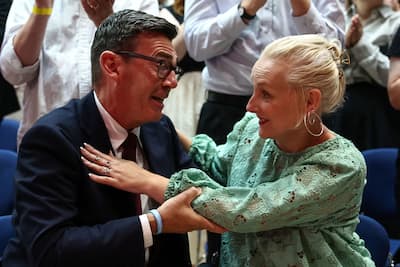
On Monday, after meeting King Charles III, he will become the seventh British Prime Minister in ten years, a sign of strong political instability in the country.
AFP
He succeeds Keir Starmer, who became prime minister two years ago after Labor’s landslide parliamentary victory, but who quickly became unpopular after missteps and U-turns.
The election of Andy Burnham as an MP on June 18 in the Makerfield constituency in northern England opened the way to Downing Street for the “King in the North”, as he is nicknamed.
After two failures to take the lead of the Labor Party – in 2010 and 2015 – Andy Burnham left London to return to the north, where he is from. He was elected Mayor of Greater Manchester in 2017.
As leader of this former industrial stronghold that underwent an economic revival, he became popular, regularly attacking the government in London.
“We will take back power in Westminter and Whitehall (the ministerial district, Editor’s note) to give it back to the place where you live,” he promised Friday in reference to his future decentralization policy, which he has not yet detailed.
However, he will have to deal with the same challenges as Keir Starmer, first and foremost sluggish growth and public finances under pressure, against a backdrop of heavy debt.
For political scientist Tony Travers, interviewed by AFP, “the main challenge facing Andy Burnham is to give the British the feeling that he has a project, and that it is an optimistic project, capable of generating growth and bringing change”.
The future prime minister and his supporters have so far “remained quite vague”, and he will quickly have to “present a concrete program and measures that people understand”, he added.
Rumors are multiplying about his future government team. According to several British media, the current Minister of the Interior Shabana Mahmood could become the Minister of Finance of the man who again described himself on Friday as a “business-friendly” leader.
His government should be announced on Monday.