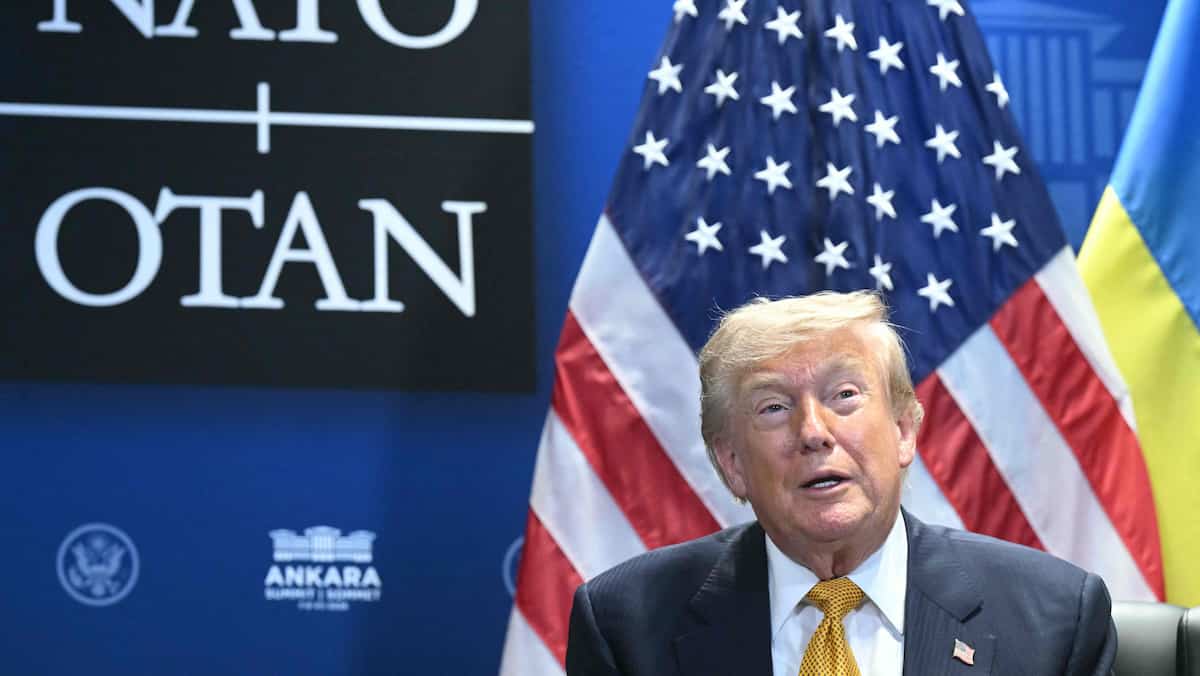

“A lot of love in the room”, according to Donald Trump: the NATO allies displayed their unity on Wednesday in Ankara, at the end of a summit during which the American president alternated virulent attacks and an extraordinarily conciliatory tone.
• Also read: NATO: 11% increase in spending in Europe and Canada in 2026
• Also read: NATO summit touts arms deals, attempts to appease Trump
In their final declaration, all Alliance countries reaffirmed their “unwavering” commitment to the mutual assistance clause, enshrined in Article 5 of the North Atlantic Treaty, the cornerstone of the organization.
“An attack against one Ally is an attack against all,” recalls the text.
On Ukraine, the 32 NATO countries also reaffirm their unwavering support for this country at war with Russia, which, affirm the Allies, “contributes to transatlantic security”.
This courtesy photo, taken and released by NATO on July 6, 2026, shows NATO Secretary General Mark Rutte speaking at a pre-summit press conference, on the eve of the 36th NATO Heads of State and Government Summit in Ankara, July 6, 2026. AFP
AFP
“I return to Germany with the feeling that (…) that NATO remains united, that it becomes stronger and more European,” summarized German Chancellor Friedrich Merz.
“There was a lot of love in the room, a lot of unity,” said the American president. “Everything was magnificent,” he added, praising his Turkish host Recep Tayyip Erdogan, in power for more than two decades, “a great leader (…) very powerful”
“We want to stay with you,” he told his counterparts earlier during the closed-door meeting, according to a source who participated.
A calm tone reminiscent of the previous summit in The Hague in 2025 where Donald Trump celebrated a “monumental success” after countries committed to devoting at least 5% of their gross domestic product to their security.
But a tone which contrasts strikingly with his remarks a few hours earlier when he had rehashed old criticisms.
“Not happy”
“I am not happy with NATO because they did not want to help us against the main state that supports terrorism, namely Iran,” he said.
He also expressed his frustration at not having been able to seize Greenland, which constitutes a “big problem” in his eyes. “Greenland is very important to the United States, but not important to Denmark.”
Donald Trump also strongly castigated Spain, described as a “lost cause”, with which the United States will, according to him, “cease all commercial exchanges”, once again accusing Madrid of not participating in NATO defense spending.
But Spanish Prime Minister Pedro Sánchez then assured he had a “courteous” exchange with the Republican billionaire, praising the “very positive” relations between Spain and the United States.
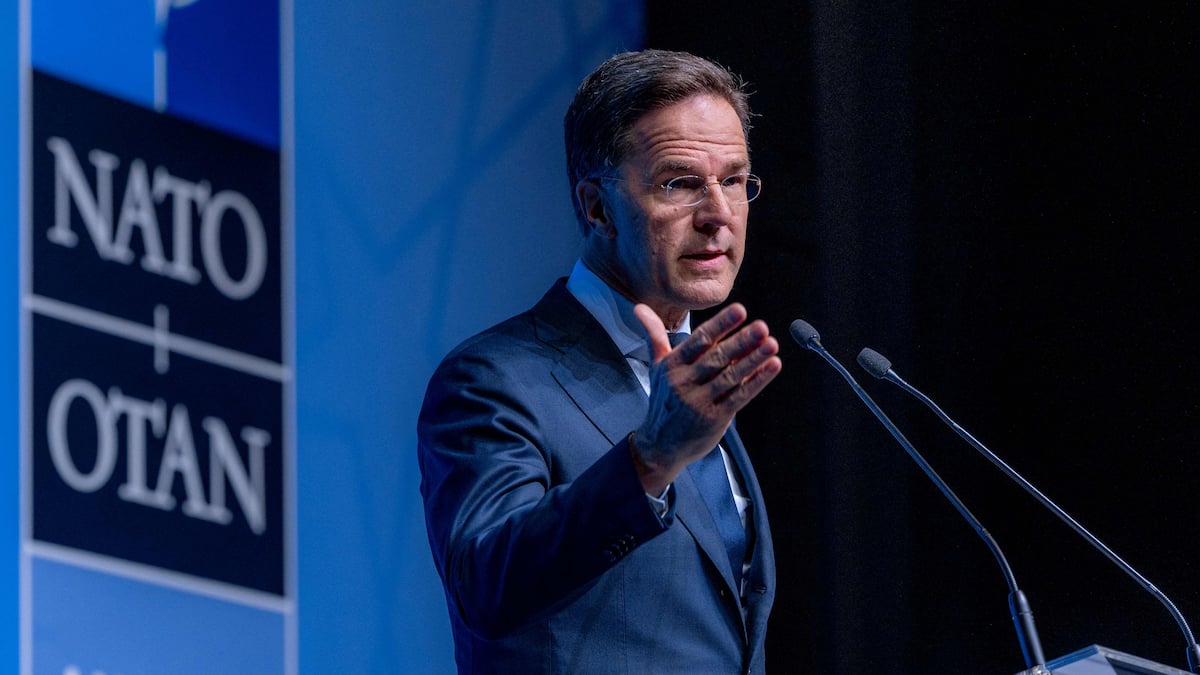
“I am here to preserve unity, or at least do my best to maintain the unity of the Alliance,” explained NATO Secretary General Mark Rutte at the end of the summit. “And that means that when there are discussions or sometimes areas of friction between Allies, I don’t comment on them in public.”
“There is a complete commitment” of the United States within NATO, he insisted, welcoming the role played by Donald Trump since his return to power.
With figures and graphs to back it up, the NATO Secretary General has been trying for months to demonstrate to Donald Trump that the commitments of member countries are followed by action. And may his calls for better sharing of the burden not remain in vain.
More European alliance
The consensus is there: the Alliance must become much more European and a little less American. But the project is immense and complex. And Washington’s pressure is creating a difficult climate.
On Ukraine, the American president’s tête-à-tête with his Ukrainian counterpart Volodymyr Zelensky was closely scrutinized, a few days after a “very good conversation” with the Russian Vladimir Putin.
Donald Trump announced that he would authorize Kyiv to manufacture Patriot missiles, essential to intercept Russian ballistic missiles which strike Ukraine.
He also estimated that the Ukrainian strikes deep in Russia, if they constituted an “escalation”, could ultimately “help” to end the war.
The next NATO summit will take place in Albania.
But it is not certain that it will take place next year. Diplomatic sources estimate that it could be prudent to space out the summits, in particular to avoid the possible anger of Donald Trump.