
The European Union welcomed on Friday with relief the new customs duties announced the day before by the United States, after concerns linked to a fine it had just imposed on the American giant Google, and against a backdrop of turbulent relations with Donald Trump.
• Also read: US replaces temporary surcharges with new 10% tariffs
• Also read: Washington launches a new round of customs duties against around sixty economies
• Also read: European Union fines Google 890 million euros, risking Trump’s wrath
“The EU is pleased that this result is consistent with American commitments on customs duties” contained in the trade agreement concluded last year between Brussels and Washington, reacted Olof Gill, spokesperson for the European Commission.
The new customs tax regime announced by the American government affecting around sixty economies in fact respects, as far as the EU is concerned, the 15% ceiling which appeared in this agreement signed a year ago almost to the day in Turnberry, Scotland.
“It establishes an all-inclusive tax rate of 10% for the EU, and reintroduces exemptions from additional customs duties on certain European products, such as cork and diamonds”, in addition to goods which were already exempt such as planes and their spare parts as well as generic medicines, noted the spokesperson.
This creates a “positive dynamic” for transatlantic discussions on different subjects, ranging from strategic raw materials to artificial intelligence, welcomed Olof Gill.
“Risk for transatlantic stability”
Washington’s announcement was made a few hours after the EU’s decision to impose a fine of 890 million euros (around $1.4 billion CAD) on Google for violations of digital competition.
This new sanction imposed against the American technology giant had fueled, on the European side, fears of possible reprisals from Washington, for example in the form of an increase in customs duties, the Trump administration regularly accusing the EU of unfairly targeting American companies via its digital legislation.
Faced with “continuous threats from Washington, we were prepared for the worst, but it did not happen,” rejoiced German MEP Bernd Lange, who played a key role in the implementation of the agreement on the European side.
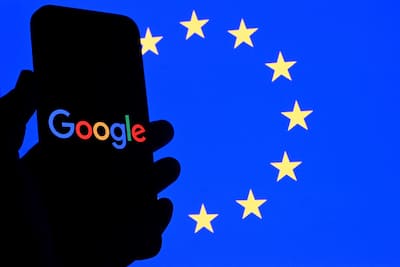
This illustrative photograph shows the Google logo displayed on a smartphone in front of a European Union flag in Brussels, September 29, 2025.
AFP
A contested justification
On the contrary, the new taxes announced seem “more favorable than expected” for European producers, with taxation lower than the 15% ceiling provided for in the Turnberry agreement and more favorable than the temporary regime put in place in February, after the decision of the American Supreme Court.
Brussels, however, unequivocally rejected the reason given by the United States for imposing these new customs duties.
Washington presented them as the result of a procedure (known as “section 301”), launched in mid-March by Jamieson Greer, to determine whether the United States’ trading partners had eliminated products resulting from forced labor from their supply chains. European legislation in this area has been deemed insufficient.
“The EU already has strong rules on forced labor and, therefore, we completely reject the idea that the EU has contributed to the global problem of forced labor,” recalled Paula Pinho, chief spokesperson of the European executive, at a press conference.
Furthermore, Europeans remain vigilant, with the Trump administration keeping an ace up its sleeve to impose new surcharges in the future. In particular, it is still conducting another investigation targeting the EU under Section 301, regarding industrial overcapacity.
Since the signing of the Turnberry Agreement, relations between the EU and the United States have been particularly turbulent, marked in particular by the repeated threats of annexation of Greenland issued by President Trump, and his strong criticism of his European allies, accused of not supporting him in the war against Iran.